
A Win at the 10th Circuit Court of Appeals for Wild Horses and the Adobe Town Roundup
July 23, 2025
The Bitter End: The Adobe Town Roundup
August 11, 2025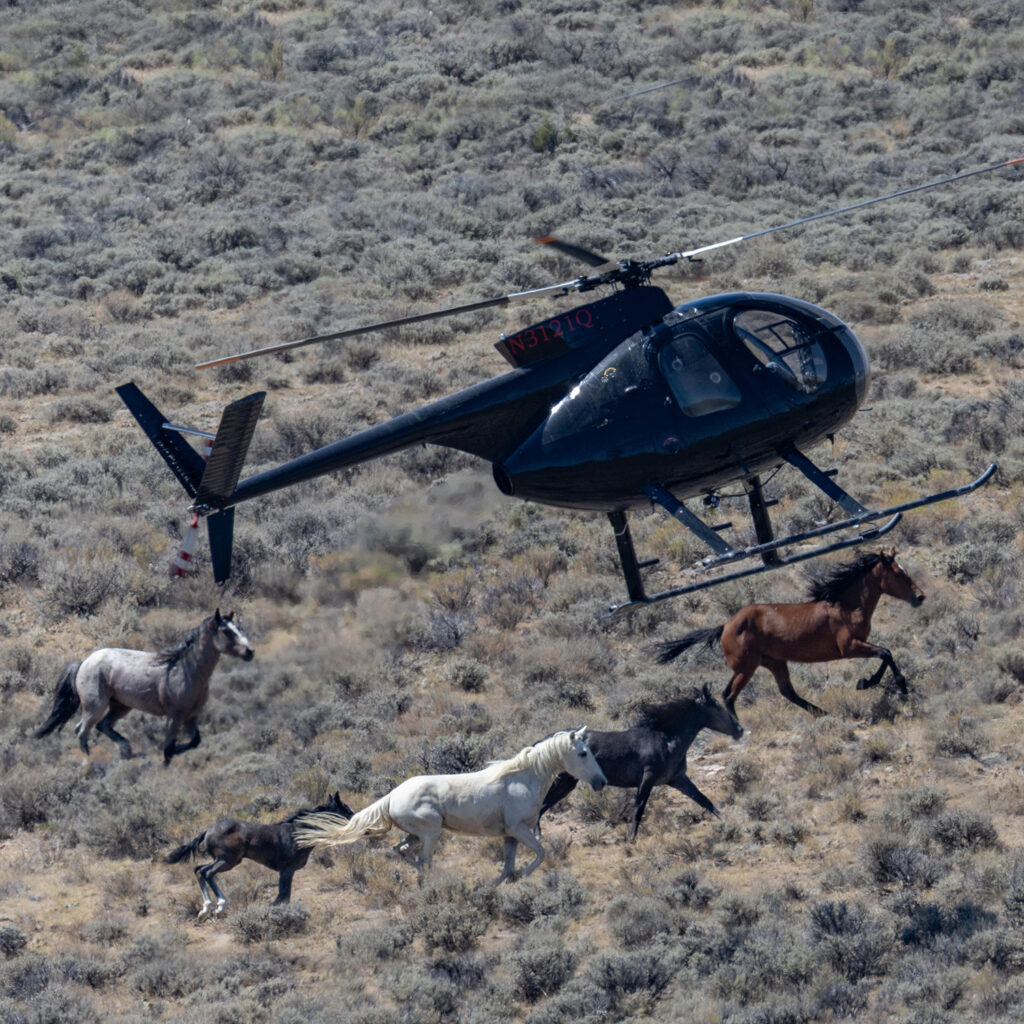
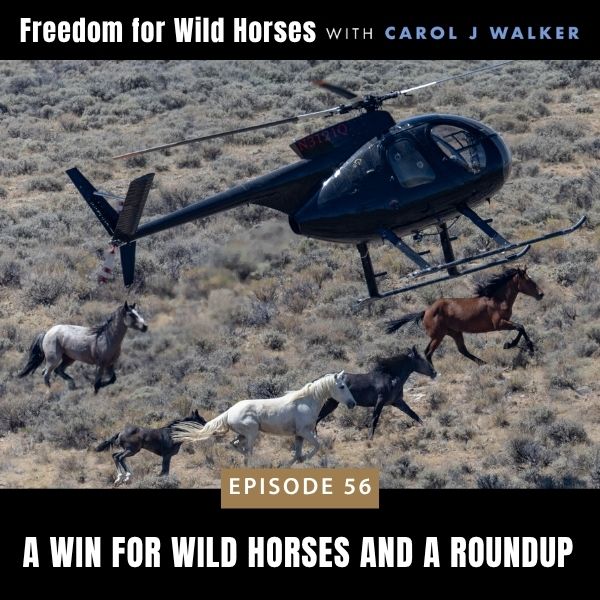
What does it mean to win in court while wild horse roundups continue on the ground? In this episode, I share the emotional highs and lows of a pivotal week in the fight to protect Adobe Town’s wild horses. Just as the Tenth Circuit Court of Appeals ruled in our favor—finding the BLM acted arbitrarily in its plan to zero out nearly 2 million acres of wild horse habitat—the helicopters were already in the air, continuing their work.
I take you behind the scenes at the Adobe Town roundup, where families who survived the deadly winter of 2022–2023 are now being chased into traps by helicopters. You’ll hear what I witnessed on the range: stallions trying desperately to stay with their families, foals calling for their mothers, and the heartbreaking reality of horses who will likely never return to the wild.
While the court ruling is a significant step forward, the roundups are not halted. The BLM’s plans for Salt Wells Creek and Adobe Town are moving forward, with future roundups scheduled. This episode is a reminder that while we’ve made progress in the courtroom, the struggle to protect these wild horses continues.
Subscribe to my blog to get more information on how you can help America’s wild horses.
What You’ll Learn from this Episode:
- What the Tenth Circuit Court ruling means for Adobe Town, Salt Wells Creek, and Great Divide Basin.
- Why the BLM’s current roundups continue despite the legal setback.
- What I observed during the Adobe Town helicopter roundup, including heartbreaking moments of separation.
- How captured horses are transported and held—and the risks they face in the process.
- Why preserving Adobe Town’s genetic diversity is crucial for the future of Wyoming’s wild horses.
Listen to the Full Episode:
Featured on the Show:
- Subscribe to my blog to get more information on how you can help America’s wild horses.
- Follow along on Facebook and Instagram!
- Living Images by Carol Walker
- Follow my blog to get updates on the coming roundup this summer: Wild Hoofbeats Blog
- Wild Hoofbeats: America’s Vanishing Wild Horses by Carol Walker
- The Zero Out EA
- Daily Report for Adobe Town Roundup
- Press Release for 10th Circuit Appeal
Welcome to the Freedom For Wild Horses podcast, the place to find out about wild horses in the American West and what you can do to help them stay wild and free. If you love wildlife, wild horses, and the freedom that they stand for, this show is for you. I’m your host, Carol Walker. Let’s get started.
It has been a week of tremendous ups and downs. On July 15th, the day the Adobe Town roundup started, I was driving and had pulled over to check my messages. There was an email from our attorney about our Tenth Circuit Court of Appeals case. We won! I yelled and got out of the car and jumped up and down. Once I had time to read the court’s decision, I realized that things were not quite so clear-cut.
The central part of the decision is that the Bureau of Land Management acted arbitrarily and capriciously in following its plan to zero out Great Divide Basin, Salt Wells Creek, and almost half of Adobe Town on almost 2 million acres of public lands. The court found that they violated federal law by failing to consider a key part of the 1971 Wild Free-Roaming Horses and Burros Act that requires them to manage wild horses as part of a thriving, natural, ecological balance on our public lands. The court reversed and remanded the decision back to the lower district court to rehear or to settle. This leaves room for the BLM to attempt to revise and reinstate their plan. It will likely be the end of this year or early 2026 before the case is heard in the district court.
The lawsuit was brought by American Wild Horse Campaign, Animal Welfare Institute, Western Watersheds Project, Kimberly Curl, Chad Hansen, and me, Carol Walker.
So what does this mean for the roundups? The roundup currently going on in the portion of Adobe Town Herd Management Area that was not changed into a herd area not managed for wild horses is about 380,000 acres. It’s not affected by this ruling other than the number of horses allowed to be in the area was reduced to low AML of 259. This roundup is to bring the herd down to that low appropriate management level. The BLM claims that there are 1,675 horses over AML, and I don’t believe the number is that high. Adobe Town was the epicenter of the horrific winter of 2022 to 2023, which killed likely half the herd, and many, many members of the wildlife community, including elk, antelope, and deer.
There’s another roundup on the schedule. The Salt Wells Creek and the portion of Adobe Town contiguous to it that has also been turned into a herd area not managed for wild horses. This roundup is scheduled to start August 25th, and it is a roundup to zero out these herds, to take all of the horses away. Now, you might say, as many people have, why are they going to go ahead with the roundup if you won your case? The environmental assessment for the roundup was not reversed and remanded.
We were waiting to find out what the BLM might do. The staff at the roundup was close-mouthed about this. But we just got this excellent news from our attorney: The zero-out roundup for Salt Wells Creek and the Rock Springs portion of Adobe Town has been postponed until October at the earliest. A delay is best for the horses, and we hope that the BLM will wait to do a roundup until after the district court rules.
In the meantime, the Adobe Town roundup is still going on, is scheduled to continue until August 15th, and as of July 20th, 524 wild horses have been captured, two have died, the mares are being shipped to the BLM facility in Rock Springs, Wyoming, and the facility at the prison in Canyon City, Colorado. The stallions are being shipped to the private facility in Wheatland, Wyoming.
I arrived at the meeting place at the Cowboy Inn in Bags, Wyoming, at 5:45 AM on July 17th. This is the third day of the roundup. We drove across the border to Colorado and drove on County Road 4 to the southern way into Adobe Town near Powder Wash. Apparently, the BLM was very concerned about horses going over the border out of their herd management area, likely because of two good water sources there. We were also told a rancher had requested a roundup here.
They captured four horses who were in Colorado before we even arrived at the observation site, and then another 20 horses in the area where the trap was before letting the public observers get into place to watch. Instead, we sat in our vehicles for an hour south of the trap. We finally were allowed to climb the very rock hill to the top, where we could see the run into the trap, but not the trap itself. I estimate we were about a half a mile away.
I learned that the contractor was Samson Livestock. Prior to the 2021 and 2022 roundups, the Coutures had been the only contractor performing helicopter roundups in Wyoming. They have a black helicopter, just one. This is what the horses hear when they are running from fear from the trap.
In the first run I observed, there were two gray stallions fighting in the back. They were absolutely gorgeous horses being chased in by the helicopter. Not just grays who are so emblematic to the Adobe Town, but gorgeous roans and bays and buckskins and palominos. All the horses looked to be in excellent condition, and indeed we were told their body score was five on the Hennessy scale, which is excellent. They were not lacking forage or water.
A family of five horses was headed to the trap when their gorgeous strawberry roan stallion suddenly stumbled and flipped over. It was shocking to see. He scrambled up hastily and tried to lead his family away from the trap, but the helicopter prevailed.
One of the families that came in was led by a proud sorrel stallion who kept eying the jute wings of the trap like he wanted to jump it. They went into the trap, but he jumped out. I spotted him running and whinnying to his family, who whinnied back. They could not follow him, and he would not leave. Two wranglers came out and tried to rope him, but he kept moving away, but not very far. Finally, the helicopter came and spent about 20 minutes chasing him, very close to him, and finally he went into the trap. But he would not be reunited with his family.
I went to temporary holding that day after a two and a half hour wait. We were allowed to go into the temporary holding facility where they’re keeping the horses that had been captured that day. Unfortunately, unlike the contractor Couture, who puts a snow fence around the pens that at least allows glimpses of the horses, Samson used thick, heavy tarps that did not allow us to see the horses. We saw one foal lying down on the ground from looking underneath. We could hear the foals whinnying to their mothers, but we could not see them, including the foal who the BLM said had been kicked but was now just fine.
My friend asked if we could go up on a small rise, and we were allowed to. And I could see the heads of stallions and some of the mares, but not the foals. Two gray mares were cuddled close for comfort. There were brief scuffles with the stallions, but no real fighting, which was amazing given how tightly packed together they were in those pens.
The next day we met at the same location, but an hour earlier, at 4:50 AM. The terrain in this area is completely different than in the rest of the Adobe Town Herd Management Area. There are many trees, cedars primarily, rocky hills and formations, rolling hills, and sagebrush.
I asked the BLM today if a count would be done at the end of the roundup to ensure that they did not take the herd below the low AML number of 259, as was done to the White Mountain herd in August 2024. He said he did not know and would get back to me. He still has not done so.
In the first run of the day, over 41 horses came in steadily, not running. The colors of these horses are so beautiful. And like Adobe Town horses do, they try to keep their families separated. This herd is not like Salt Wells Creek, where grouping up together in large numbers is something they enjoy.
As the day goes on, trailers are loaded with the captured horses. We can see the trailers leaving, but not being loaded. And another member of the public notices that a gray stallion is down in the back of one of the trailers. We tell BLM staff who radios down, and they bring the trailer back and get the stallion up. It would be a long ride where he could not get up and would possibly be trampled, so I was glad that they got him up. They also told the staff to make sure when the trailers left that none of the horses were down in the trailers.
There was a group of about 40 horses that came in or were on their way to come in, but nine split off and ran up the hill, so the helicopter brought the bigger group in. They were very sweaty, which really shows up on the gray horses. The helicopter went out for a very long time and finally got the missing nine horses that had peeled off. They were extremely sweaty. At the end of the last run, we returned to our vehicles and were kept waiting for two hours before we were allowed to leave.
The next day, when we again met at 4:50 at the Cowboy Inn, I was surprised to hear we were going back to the same location. They are clearly determined to get every single horse in this area that I believe had not been rounded up since 2017 when I was there. This makes me even more concerned about taking so many horses from one location. Are they going to leave less than 100 horses in the whole herd, despite the fact that they are not supposed to take the herd below the low appropriate management level of 259?
There are more roans in this area than I’ve seen in a decade. These are valuable genetics that will be lost in the casual cruelty of getting them all in one area. There were mainly families here with just a handful of bachelors, which leads me to believe this might be a pocket that escaped the worst of the killer winter. Areas north of here over the last two years I’ve observed have had many bachelors and few families, which makes sense as the mares are more likely to die in the harsh winter. The group of 33 horses that come in try to stay separated by family, and they have a stunning pale palomino stallion with a long mane in front. The BLM had told us prior to the helicopter’s approach that there were riders out to help a pale foal if he had trouble coming in. Yet there he was, running with his mother at the end of the group. Then, a small family with a pure white stallion with a long snowy mane, who reluctantly followed his family into the trap. The last to be captured were two young bachelor stallions who ran very fast to escape the helicopter, but still finally were chased into the trap by the helicopter.
Once we went back to our vehicles, we were told that they were going to go back to the same area tomorrow, which I found very concerning. They also went back on Monday.
And there were three deaths on Sunday and Monday, after I left. A foal died of capture myopathy, which is a fancy way to say they ran it to death. And two horses died in the trailers. Given how they stuffed those horses in there, it should not be a surprise. Yet it is a horrible reality with a contractor in a hurry, who has no care for the well-being of the horses they capture and transport. And July is a terrible time to round up wild horses because of the heat, and because yes, it is still foaling season, and I saw several foals that were only a couple of days old. They should not have been running from the helicoptor.
I left for home with a very heavy heart. So many incredibly beautiful horses who will never see their families again, and most will never leave the holding facilities. Adobe Town is an area very close to my heart. It’s the first place I visited and fell in love with wild horses on my first trip out in 2004. I observed my first roundup there in 2005 and firmed up my determination to help save these wild horses.
I wrote my first two books, Wild Hoofbeats and Galloping to Freedom, about the wild horses in this area and the situation facing them. I have been observing every roundup of this herd since 2005, and I’ve been dedicated to making sure that the horses are treated as humanely as possible. I’ve been a plaintiff on many lawsuits to save this herd and others in the checkerboard area of Wyoming. The fight to save them is not over.
Thank you for listening to this episode of Freedom for Wild Horses. To go to the links about the roundup, go to my www.wildhoofbeats.com website and look for the podcast there. Thank you for listening to this episode of Freedom for Wild Horses. If you want to learn more, follow me at www.wildhoofbeats.com for more information and for ways to help America’s wild horses. See you next time.
Enjoy the Show?
- Don’t miss an episode, follow the podcast on Apple Podcasts, Spotify or RSS.
- Leave us a review in Apple Podcasts.
2 Comments
I listened for the first time today . I will continue to be educated by you and others . My heart is heavy , abd I am sure yours is very often during your observations of these roundups . Thank you so much for sharing with us .
Thank you for listening and most of all for caring about our wild horses.