
Ep #66: The Winter that Wasn’t with the Wild Horses of Salt Wells Creek
March 16, 2026
Ep #67: Planning for the Red Desert Complex Wild Horses Needs Your Comments
April 20, 2026Wild Horses in Wyoming’s Red Desert Complex Need Your Comments
by Carol J. Walker
On March 25 BLM issued a press release for a Scoping Document for the Red Desert Complex in Wyoming with public comments due by May 4. In commenting on a Scoping Document, the public has the opportunity to tell the BLM what to analyze, which is why this is so important. This Scoping is being done in order to create a Herd Management Area Plan (HMAP).
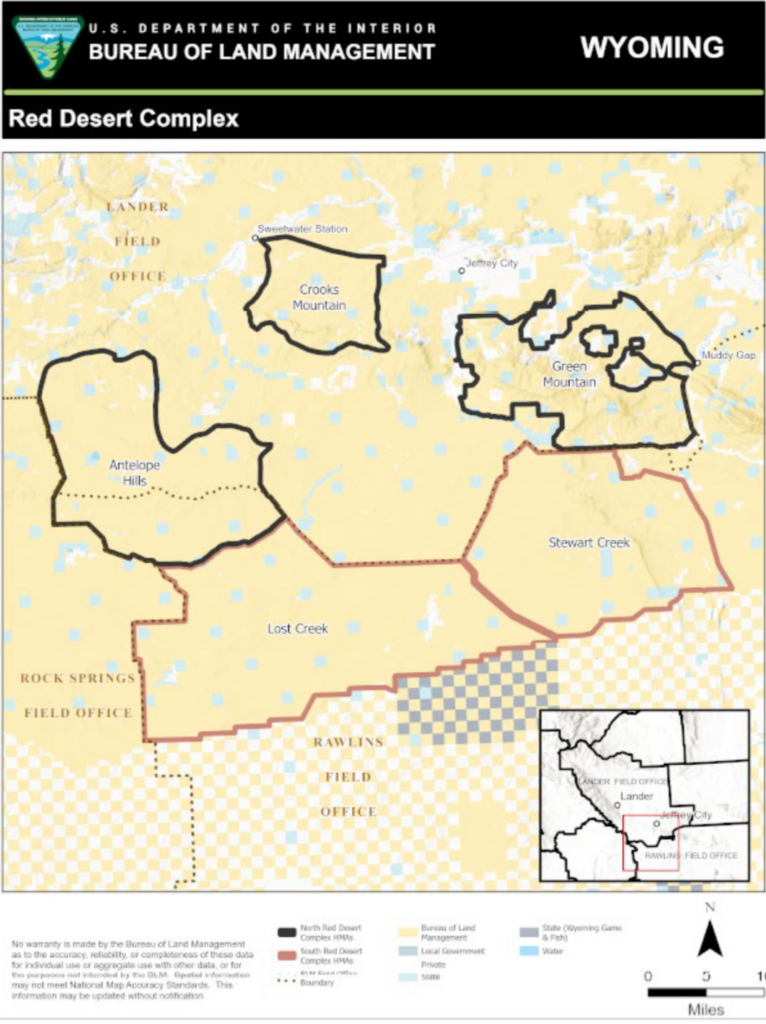
Arapahoe Creek HA is in the middle – the so-called “donut hole.”
The BLM proposes a Herd Management Area Plan for 5 wild horse Herd Management Areas in Wyoming consisting of 753,000 acres which they have divided up into two parts. They actually cannot do this without a change to the Land Use and Resource Management Plan, but this is what the Scoping Document says:
The North Red Desert Complex: Antelope Hills, Crooks Mountain, and Green Mountain Herd Management Areas, with about 333,694 acres. It is managed by the Lander Field Office.
The South Red Desert Complex: Stewart and Lost Creek Herd Management Areas, with about 419,000 acres. It is managed by the Rawlins Field Office. The BLM has never before changed the Red Desert Complex into two different complexes.
No mention is made of Arapahoe Creek Herd Area, which lies in the middle of these 5 HMAs, because it is not managed any longer for horses – it is dismissed as the “donut hole” and wild horses within its confines are classified as “off-range.” More about that as I continue.
The Appropriate Management Level for the whole of the Complex, north and south together is 480-724 wild horses. This number was set over 30 years ago and has not been revised since. AMLs are not supposed to be set in stone but should change as conditions change on the ground. Many of these Herd Management Areas have AMLs at 80 horses, far below the number needed to ensure genetic viability and the reasoning given by that is that the horses move between the HMAs and there is cross breeding, and this even comes up in the section of the documents devoted to genetic viability, which was found to be good and of “a single interbreeding herd” with some “limited population subdivisions,” “Beneficial to the maintenance of long term genetic diversity.”
And where do most of the wild horses cross into other HMAs? Through Arapahoe Creek HA. The horses from the different HMAs meet and mingle and breed there. I have been observing and photographing the wild horses of the Red Desert Complex since 2016, several times per year. I have witnessed bands moving from one HMA to another, through the HA.
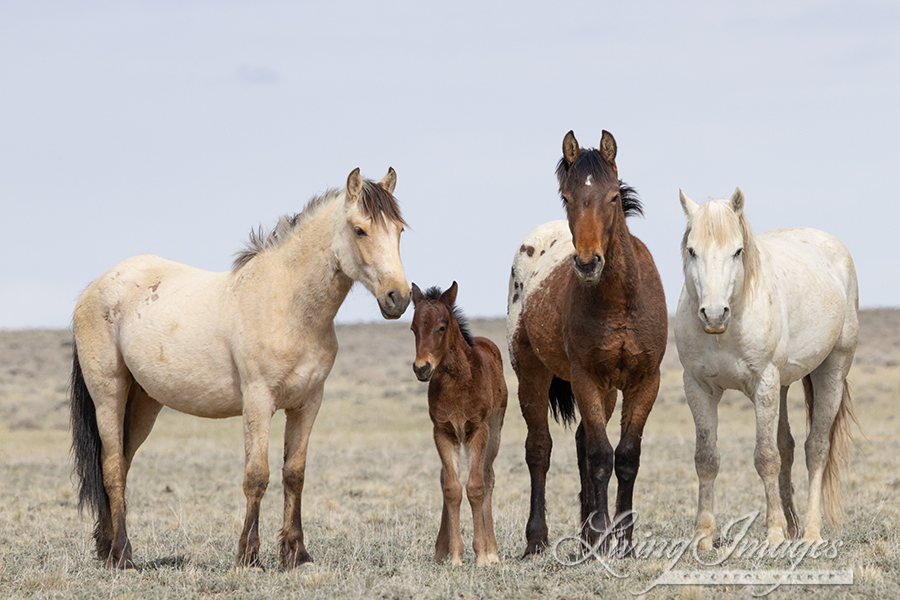
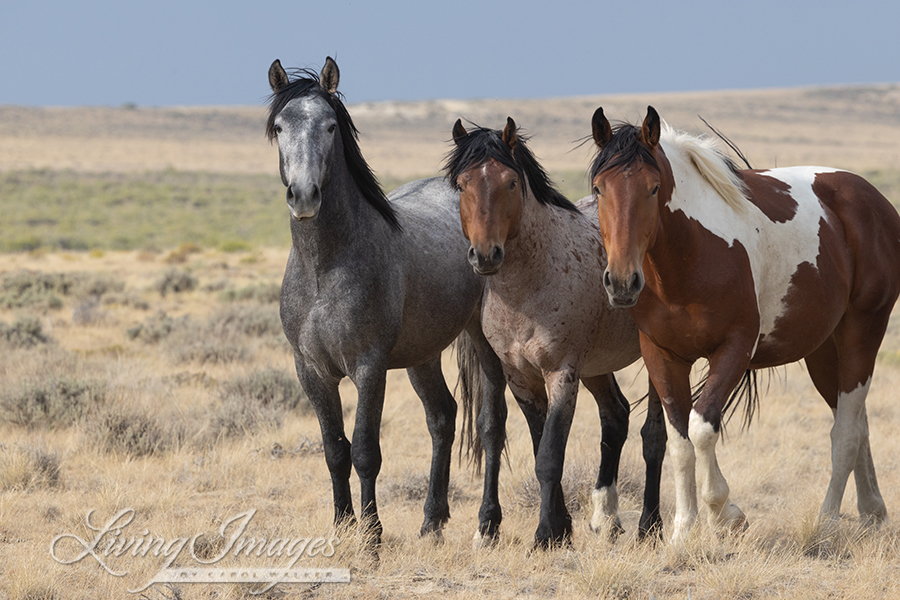
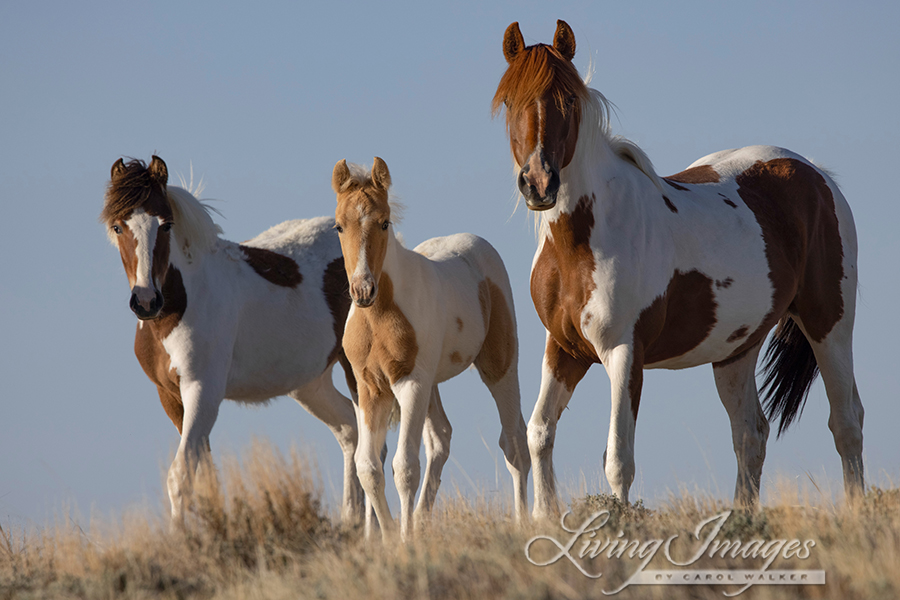
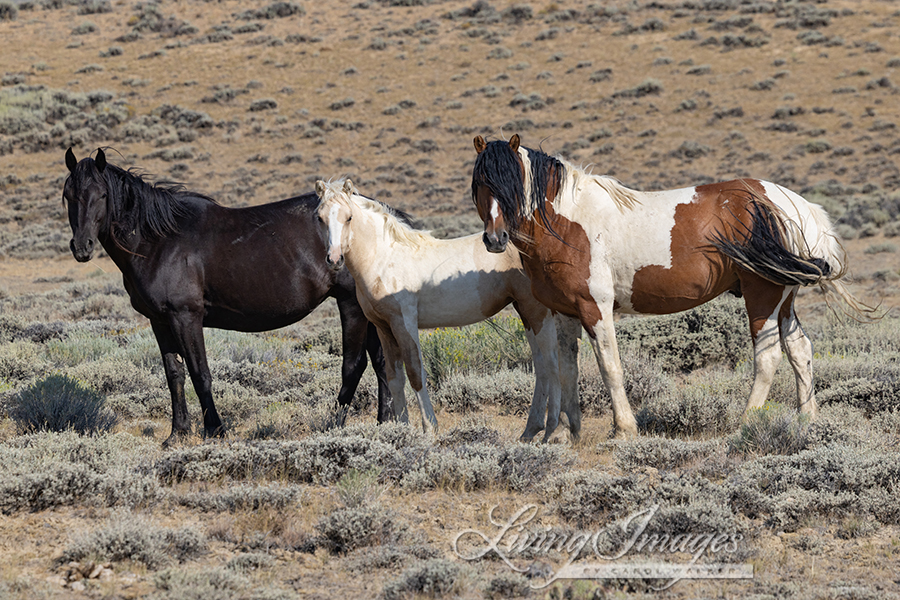
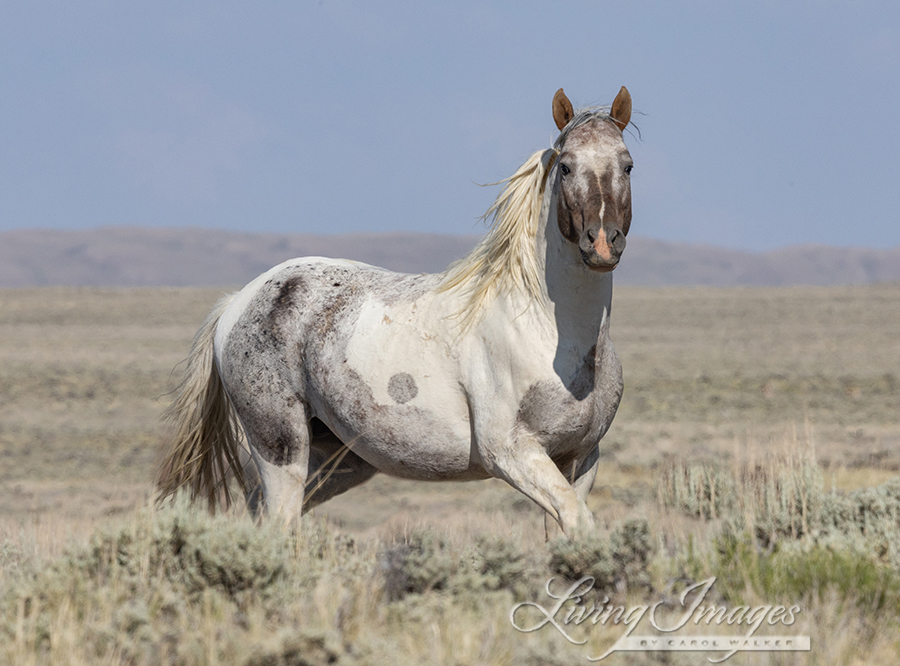
There are distinctions in color between the HMAs. Stewart Creek has many Appaloosas, mostly varnish roans, Crooks Mountain has many bays and some pintos, Green Mountain has many blacks and pintos, Antelope Hills has the most Spanish of the herds, including some amazing buckskins and duns with primitive markings. Lost Creek has quite a bit of Spanish blood as well with many pintos. And Arapahoe Creek is a mixing bowl of all the HMAs.
The last roundup was in the fall of 2020 when 1970 wild horses were captured with helicopters, 10 died and 197 were returned.
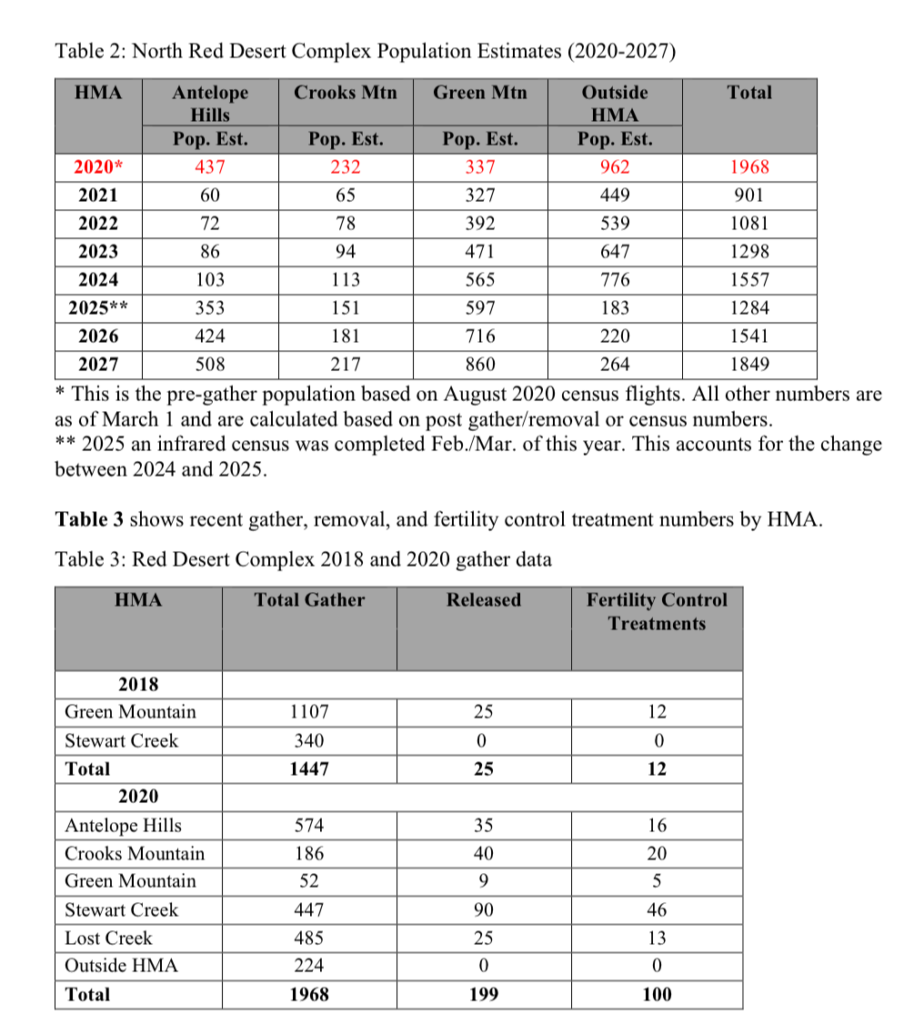
The population “estimates” are wildly skewed and don’t take into account the devastating winter of 2022-2023. Just adding 20% every year to the numbers is not an accurate way to assess the population of the Complex. Also movement of the horses between the HMAs is not accounted for. This is the table from BLM’s Scoping Document.
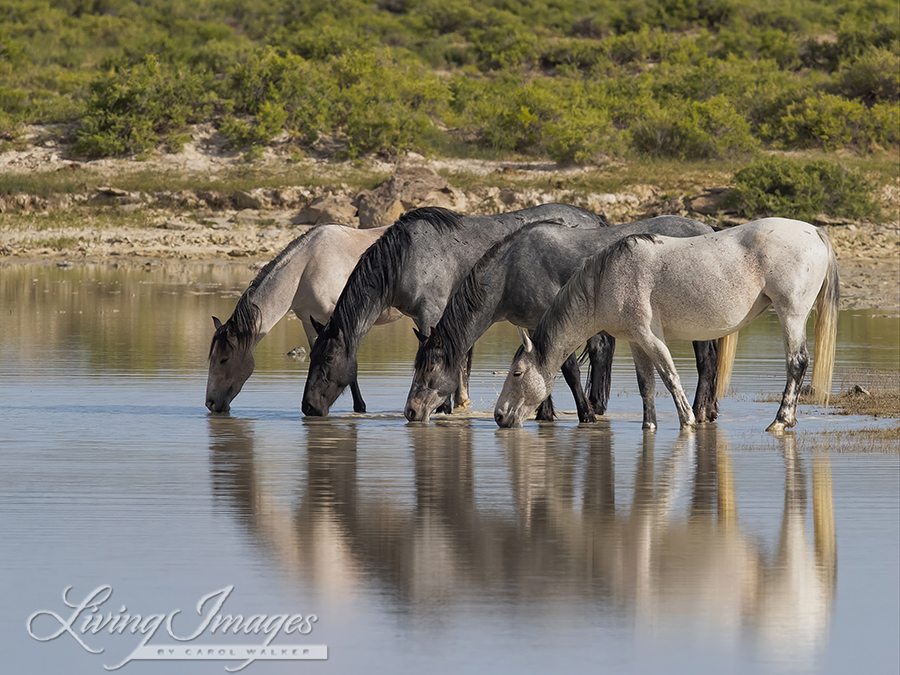
There has been tremendous movement of horses since the catastrophic winter of 2022-2023 and then the drought of last year. Horses are moving in ways I have not seen before and these changing conditions with the record low snowpack of this year, lowest since 1981, means the BLM should be taking current and future conditions into account when making a HMAP. Sweetwater County, South Red Desert, was designated a USDA Natural Disaster Area due to drought conditions in 2025. The BLM should also be taking into consideration present and future mining operations which take a tremendous amount of water. Additionally, in summer a cow-calf pair, 1 AUM, uses 40 gallons of water a day. A wild horse, 1 AUM uses 15 gallons per day. Which population is more suited to resisting drought?
It is completely inadequate for the BLM to say:
“It is important to note that these HMAs are not exclusively used by wild horses. In accordance with BLM’s multiple user mandate, there are many other legal users of this land within these HMA boundaries. This can make attributing impacts to a specific land use or user difficult. When talking about impacts to forage, water and space, blame is often attributed to the “other” users. As this relates to wild horses, it is clear that wild horses are contributing to impacts on the landscape, but they are not the only contributors. By the same token, other users other users also contribute to these impacts and cause their own unique impacts which may directly or indirectly affect wild horses. The purpose of this management evaluation is not to parse out impacts by resource uses. The goal of this evaluation is to compare current use with past use, and to identify any future changes relating to wild horses that need to be made.” (Page 18).
This is extraordinary, and not in a good way. In fact, exactly what they should be doing is working out how each user of the land is impacting it – otherwise they are just throwing up their hands and scapegoating wild horses for damaging riparian areas and drinking all the water, without making any determination about the impacts of cattle and sheep. “Large populations of wild horses often strain these key water supplies and riparian zones….many run dry during summer.” There will be drought this summer and BLM must not be allowed to blame wild horses for all impacts. They must analyze the impacts for all users. They must analyze and propose range improvements to help deal with the increasing drought and improve water resources for wild horse use. BLM should map out all water resources and list those with fences that block access to water, fix broken springs, wells and pipelines. Wells that are turned off by ranchers when no cattle are in the area should be evaluated. Interestingly, Arapahoe Creek Herd Area, where there have been wild horses for decades, is the most water rich area of all – and it was changed from a HMA to and HA. It should be changed back to a Herd Management Area, recognizing that it is central to all the HMAs and an integral part of the Complex.
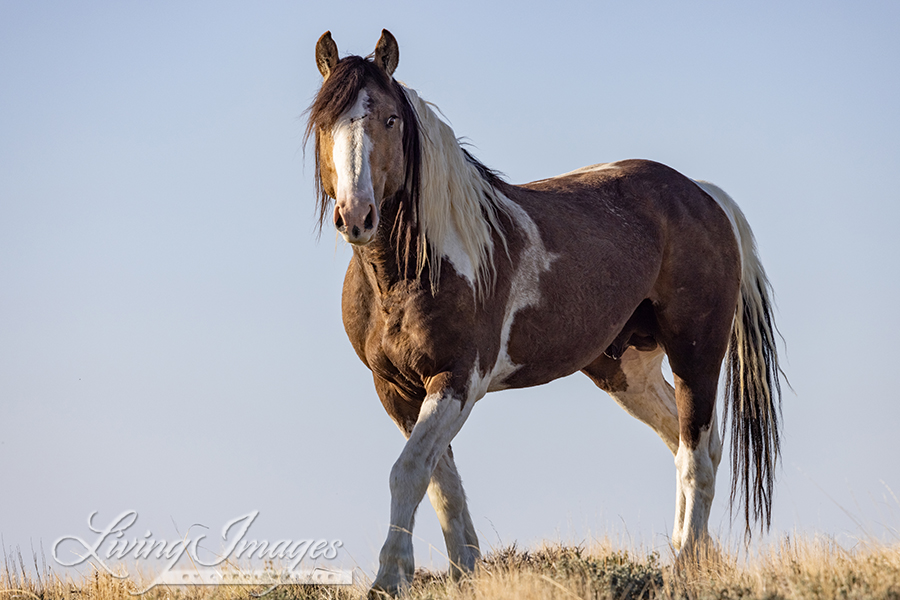
Regarding birth control – “aggressive” measures are not needed. Just because the BLM administers PZP during a roundup and does not follow up with more treatments until the next roundup 6 or 10 years later does not mean that the birth control has failed. Rather it is a failure of the BLM to administer it properly. There is no need for unscientific and unproven sex ratio skewing. The sex ratio in the Complex was already wildly skewed stallions to mares by the extreme winter of 2022-2023 due to pregnant and nursing mares being more vulnerable. Do not skew the sex ratio even further, which will result in greater instability for the herds. Sex ratio skewing has no scientific data showing it works in population control. There is no need to use GonaCon, a known sterilant, and no need to geld stallions. Darting mares is possible – traps can be set up at water sources. Documentation of the herds must be done. All this takes time and manpower but it is possible. Birth control darting has been being done already in Stewart Creek. Planning needs to be done in order to implement birth control across the Complex.
I visited Antelope Hills, Green Mountain, Lost Creek, Stewart Creek and Arapahoe Creek in February of this year. All the horses that I saw were in good to excellent condition coming out of a very mild winter.
Here are some talking points to use in crafting your own comments, which are most valuable when in your own words. Signing onto a form letter will not be useful for your comments – they will not be considered. This is a list to start from, it is by no means exhaustive.
1. Study and present the impact of all users of the Complex. Use data, tables and maps.
2. Study, map and present the movement of the horses throughout the Complex, between HMAs and include barriers like fences. If BLM must use “north” and “south” to divide the Red Desert Complex, then they must show how the horses cannot move between them. If there are plans to keep this designation, it must be included in a Resource Management Plan.
3. Study and display information on the historic and essential area of Arapahoe Creek, and restore this Herd Area to Herd Management Area status. It is an essential part of maintaining genetic viability of wild horses as well as providing important water and forage to maintain healthy wild horses.
4. Redesignate “foaling season” as March 1 to October 1. July is the height of foaling season, not the end.
5. Repair and support water sources. Inventory all springs, troughs, ponds, lakes, tanks, wells and document their condition and what users can access each one and for how many months. Repairing water access will be a vital tool to spread out wild horse use of the Complex.
6. Show in detail where the current RMPs for Lander and Rawlins are inadequate and no longer match current conditions. Include impacts of human, mining, drought, wildlife, sheep and cattle use.
7. Make amendments to the RMPs that will match the reality on the ground and include a section for wild horse management rather than removal.
8. Plan to use humane, reversible birth control like PZP instead of sterilization. Document wild horses on the range. Saying it is too hard to implement fertility control on the range and then using helicopters to roundup and remove the horses every few years is unacceptable. Do not skew the sex ratio of stallions to mares – there is no scientific data showing this works to control population growth and it just results in greater instability for the herds.
You can view the three documents and submit your comments here:
https://eplanning.blm.gov/Project-Home/?id=6c9a6ab7-c027-f111-8341-001dd804183b&
Use the green “Participate Now” button.
Please comment by May 4, 2026 at 4 pm MT.
32 Comments
Thank you Carol,
This was extremely helpful in submitting my comments. I am well aware this subject takes time to be fully educated on and I appreciate your dedication to informing those of us who feel passionate, but want to make sure we stay purposeful. I feel like reading through your talking points is a bit of a “Boot Camp”, along with your other blog posts and podcast as well. Thank you for your guidance!
Thank you! Boot camp indeed 🤣
I am hoping and praying that these Beautiful and precious Horses and mules will not need to be relocated and I know the Land Management wants to proceed with their plan.
No mules or burros in Wyoming.
1. Study and present the impact of all users of the Complex. Use data, tables and maps.
2. Study, map and present the movement of the horses throughout the Complex, between HMAs and include barriers like fences. If BLM must use “north” and “south” to divide the Red Desert Complex, then they must show how the horses cannot move between them. If there are plans to keep this designation, it must be included in a Resource Management Plan.
3. Study and display information on the historic and essential area of Arapahoe Creek, and restore this Herd Area to Herd Management Area status. It is an essential part of maintaining genetic viability of wild horses as well as providing important water and forage to maintain healthy wild horses.
4. Redesignate “foaling season” as March 1 to October 1. July is the height of foaling season, not the end.
5. Repair and support water sources. Inventory all springs, troughs, ponds, lakes, tanks, wells and document their condition and what users can access each one and for how many months. Repairing water access will be a vital tool to spread out wild horse use of the Complex.
6. Show in detail where the current RMPs for Lander and Rawlins are inadequate and no longer match current conditions. Include impacts of human, mining, drought, wildlife, sheep and cattle use.
7. Make amendments to the RMPs that will match the reality on the ground and include a section for wild horse management rather than removal.
8. Plan to use humane, reversible birth control like PZP instead of sterilization. Document wild horses on the range. Saying it is too hard to implement fertility control on the range and then using helicopters to roundup and remove the horses every few years is unacceptable. Do not skew the sex ratio of stallions to mares – there is no scientific data showing this works to control population growth and it just results in greater instability for the herds.
Please submit your comments to the BLM here: https://eplanning.blm.gov/Project-Home/?id=6c9a6ab7-c027-f111-8341-001dd804183b&
There has been tremendous movement of horses since the catastrophic winter of 2022-2023 and then the drought of last year. Horses are moving in ways the advocates who follow these herds have not seen before and these changing conditions with the record low snowpack of this year, lowest since 1981, means you-BLM-should be taking current and future conditions into account when making a HMAP. Sweetwater County, South Red Desert, was designated a USDA Natural Disaster Area due to drought conditions in 2025. You-the BLM-should also be taking into consideration present and future mining operations which take a tremendous amount of water. Additionally, in summer a cow-calf pair, 1 AUM, uses 40 gallons of water a day. A wild horse, 1 AUM uses 15 gallons per day. Which population is more suited to resisting drought?
Please send your comments to the BLM here: https://eplanning.blm.gov/Project-Home/?id=6c9a6ab7-c027-f111-8341-001dd804183b&&fbclid=PARlRTSARcfBJleHRuA2FlbQIxMQBzcnRjBmFwcF9pZA8xMjQwMjQ1NzQyODc0MTQAAac64evSxJxf70Nn-WiINqHZR5lZ7Se9zCIigZG9kkEZswXiZvKU7wKK9bQZCA_aem_XHxwButIFW0YBP5xQitohQ
I sent an email to the blm
Thank you for this complete & up to date report on our beloved horses.
Absolutely protect and allow the wild horses of this area to live in peace on this land .
No BLM intervention.
Helen please comment on the BLM website. This is where the comments count: https://eplanning.blm.gov/Project-Home/?id=6c9a6ab7-c027-f111-8341-001dd804183b&&fbclid=PARlRTSARcfBJleHRuA2FlbQIxMQBzcnRjBmFwcF9pZA8xMjQwMjQ1NzQyODc0MTQAAac64evSxJxf70Nn-WiINqHZR5lZ7Se9zCIigZG9kkEZswXiZvKU7wKK9bQZCA_aem_XHxwButIFW0YBP5xQitohQ
Save and protect wild horses of this Arapaho area.
Ok
Arapahoe is very important for the genetics of all wild horses. How does the BLM not get this
I keep commenting here accepting and move on
Do not harm the Arapaho herds
Thanks so much for your intelligent analysis of what is happening to these legally protected mustangs and their habitats, Carol. This will prove very valuable for me in composing my input to BLM. You remember I and James Anaquad Kleinert did a pro se legal suit against the outrageous plans for the wild horses in Wyoming several years ago and you gave valuable declaration. Seems we need a real shakeup as concerns the fairness issue in the BLM and giving this public input, each one with his or her own special contribution can make the big positive difference that we need!
100 bucks on the fact that 99.9% of the BLM horse bullies are clueless about the environmental benefits from Horses and burros. These animals heal the land and it’s the cattle that destroy it but maybe they do know this but maybe it’s an extra change in their pockets that helps them forget about it.
It’s an unacceptable situation that must be remedied, Linda, through understanding and education and putting this into practice in our lifestyles.
The BLM needs to stop all roundups. It’s abusive, expensive and not necessary. The horses and burros are a part of the landscape. Stay out of it and let nature balance. Leave the predators on the land and they’ll get in a rhythm.
The THE BLM is not rounding up for the sale of the horses but for access to the land for mineral and water rights and a small portion for ranchers.
Without the roundups, and stock pens the BLM will be saving millions of dollars. No need for vet, farrier, feed.
The horses have no shelters and protection from overcrowding nor weather in the pens. They are better off in the wild. If the. BLM was really rounding them up for the benefit of the horse, it’s on their dreams. The pens are not better. If they are concerned for the land, the cattle do the damage to the land, creeks and lakes. The horses do little damage if any, to the land.
If they want to feed, they already have the helicopters, drop hay. Really, way cheaper than roundups and penning. The law written back in the’70’s had been changed so much there is no resemblance to the original. There is no thought for the animals anymore. We should be better than that. The remaining land needs to be preserved from Man and development. We need to work on land already claimed. Leave what’s left, alone. Stop the sprawl.
I so agree with many statements here. Mostly that we must take in consideration all areas and show some careful planning. The wild horses need protection and care. Please consider that they were on the land prior to any cows or sheep. We need to protect them they are our heritage.
Please consider the well thought out and well presented study by Carol Walker… There must be some compromise and consideration for blood lines and historic value of these horses. Eradication is not the solution. It’s taking away the history of these lands and the beautiful horses that thrive here..
Please submit your comments to the BLM here: https://eplanning.blm.gov/Project-Home/?id=6c9a6ab7-c027-f111-8341-001dd804183b&
DO NOT ROUND UP ANY HORSES. USE PZP FOR CONTROL, NOT STERILIZATION. NO MORE SUPPORT FOR RANCHERS OVER WILD HORSES.
Please submit your comments to the BLM here: https://eplanning.blm.gov/Project-Home/?id=6c9a6ab7-c027-f111-8341-001dd804183b&
I’m a Canadian but I still need to please request that you leave the Red Desert mustangs free. They need to be managed humanely using contraceptive darting. Please leave this and all Mustangs free. I would love to see them once America straightens out!
Done. Thank you Carol for your diligence in fighting for our wild ones.
I was not able to leave a comment yesterday. But after speaking with my Representative, they gave me email addresses. I sent multiple emails. Praying for our Wild Horses. A~
The roundups are going to start in October – are there any lawsuits to stop it ? Sorry coming late to this important topic
The roundups are going to start – are there any lawsuits to stop it ?
Yes October 15, no, no lawsuits filed.