
Ep #65: A Year for Wild Horses
February 16, 2026Wild Horses in Wyoming’s Red Desert Complex Need Your Comments
April 12, 2026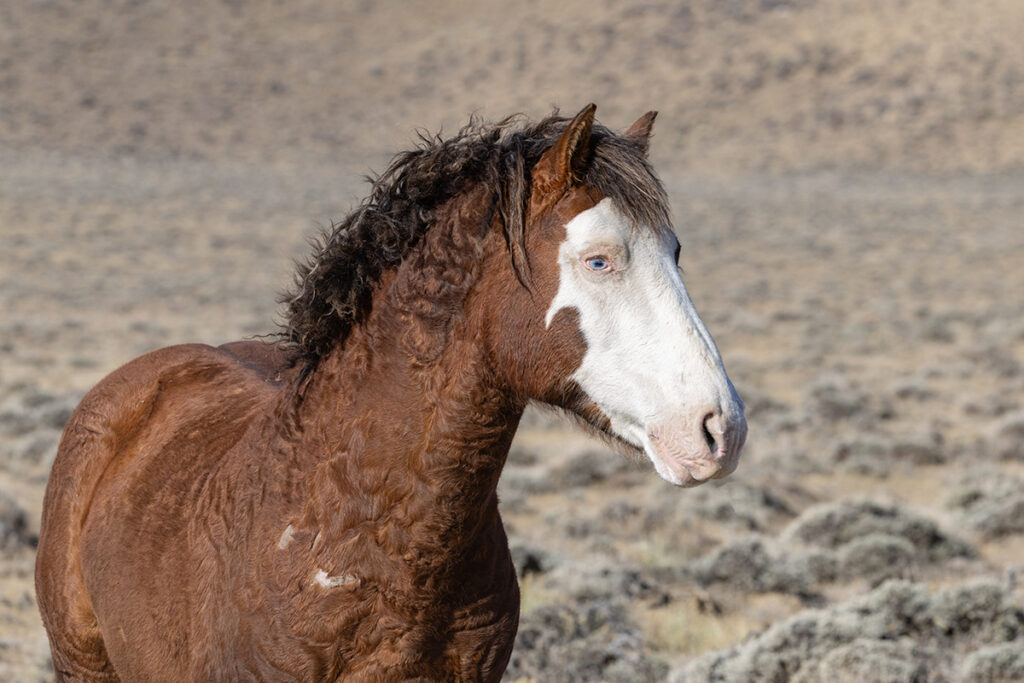
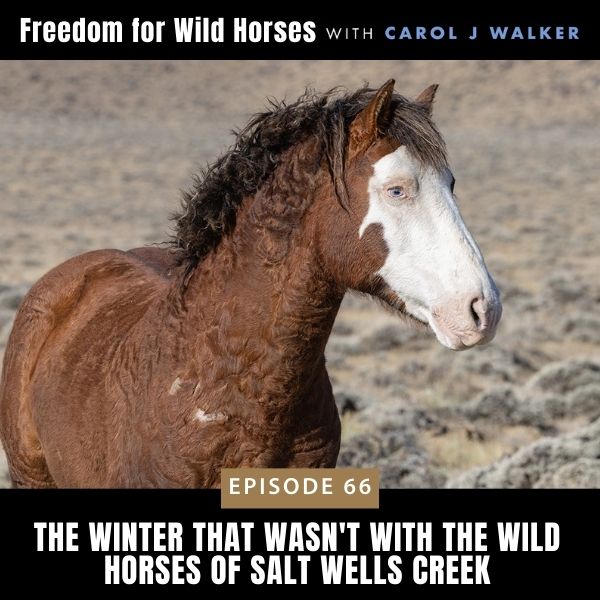
What is it like to visit the wild horses of Salt Wells Creek during a winter with almost no snow? In this episode, I share what I saw during my recent trip to this Wyoming range, where unusually dry conditions made travel easier but also raised concerns about the lack of moisture across the region.
Despite the dry winter, the horses I encountered were in excellent condition, with plenty of forage and water available in creeks and springs. You’ll hear about several of the families and bachelor stallions I observed during my time in the range, including familiar horses I have followed for years and new foals born outside the official foaling window defined by the Bureau of Land Management.
This visit also highlights how wild horses organize themselves during winter, when survival takes priority and conflicts between stallions are often subdued. I reflect on the families I observed, the young horses growing within those bands, and why understanding the realities of wild horse life on the range matters when decisions are made about how they are managed.
Subscribe to my blog to get more information on how you can help America’s wild horses.
What You’ll Learn from this Episode:
- What conditions were like during a snowless winter in Salt Wells Creek.
- How the wild horses were faring despite the lack of winter moisture.
- Which family bands and bachelor stallions were observed during this visit.
- How wild horse behavior changes during winter months.
- Why foals are often born outside the BLM’s official foaling season.
- What this visit reveals about life for wild horses on the range.
Listen to the Full Episode:
Featured on the Show:
- Subscribe to my blog to get more information on how you can help America’s wild horses.
- Follow along on Facebook and Instagram!
- Living Images by Carol Walker
- Follow my blog to get updates: Wild Hoofbeats Blog
- Learn more about my book, Wild Hoofbeats: America’s Vanishing Wild Horses by Carol Walker
Episodes Related to the Wild Horses of Salt Wells Creek:
- Ep #11: Tales from Salt Wells Creek
- Ep #55: Saying Goodbye but Still Fighting for the Salt Wells Creek Wild Horses
- Ep #60: Connecting with the Wild Horses of Salt Wells Creek and the Red Desert Complex
Welcome to the Freedom For Wild Horses podcast, the place to find out about wild horses in the American West and what you can do to help them stay wild and free. If you love wildlife, wild horses, and the freedom that they stand for, this show is for you. I’m your host, Carol Walker. Let’s get started.
The last two years, I visited wild horses in Salt Wells Creek in Wyoming in February, and there was so much snow that I could only travel down a couple of roads, and the horses were difficult to find. This year, in both Northern Colorado where I live and in Southwestern Wyoming, there has been virtually no snow all winter. The lack of moisture is alarming, and of course, we hope for much more before summer comes.
But the horses were in excellent condition. I didn’t see a thin horse. There was plenty of forage as well as plenty of water in the creeks and springs. And other than my first day in Salt Wells Creek, where a little rain caused enough mud to slip and slide before I beat a hasty retreat, I was able to get down all the roads and most of the two-tracks that I normally travel to find wild horses.
The first horse I saw on this trip was a sorrel bachelor stallion, and he was running flat out with wisps of snow on the mountains behind him. He was on a mission to get to a family of horses. I drove as far on the roads in the southern part of the range as I could until I had to turn around for fear of being sucked down by the mud. As I drove toward Rock Springs on Highway 191, I saw a big group of horses near the road.
Ace of Hearts, the stunning four-year-old sorrel curly stallion son of Jack of Hearts was there, and he moved quickly away. Then I realized that Zorro, a big wild curly black stallion with a bent ear was there. But he seemed to be in his usual bachelor state, not in charge of the family. That fell to the young black stallion Jet, son of Bobby, who calmly stood in the middle of the mares as they were grazing.
As I continued up the highway, I saw a large group of elk not far from the road. As I stopped to admire them, they bounded off, beautiful in the afternoon light peeking through the clouds.
The next morning, as I drove into the range from the road to Maggie Springs, the wind was blowing, and I saw a family of horses run across the road with the dust kicking up over the road, and the wind almost blew me off my feet. It turned out to be the gorgeous seal brown curly stallion Coyote and his family.
Then I saw three young bachelor stallions. One sorrel curly, Joker, who looks just like his father, Jack of Hearts, a black stallion, and a bay stallion. They were curious and watched me closely. Further up the road, I spotted a large group of horses. And looking through my binoculars, I was able to make out Teton’s unmistakably loud, red, and white pinto markings. I drove up and down the road several times, down two-two tracks, and finally found a two-track that led out to them.
There were about six or seven families standing butts toward the wind. As I drove near them, they watched but did not move, and I carefully climbed out of my car, wrapping a scarf around my head, and walked toward them, holding on to my camera for dear life.
I was delighted to see a new sorrel filly in Sid’s band. She was nursing on her sorrel mother, and Sid and Lieutenant Teton were keeping watch over the family. Teton has been with Sid’s family now for three years, as the family has grown from one mare and a foal to now several mares and youngsters, and now little Firefly, the new filly. She is very brave and watches me, unafraid and curious. Her fluffy winter coat is keeping her warm.
Right next to Sid’s family is one of my favorite wild horses, the curly cremello stallion Julian, whom I’ve known since he was a fuzzy little baby. His winter coat is dense and textured, and his sensitive blue eyes are closed against the sun. His rather unorthodox family is made up of four other stallions, a dapple gray mare, her two-year-old dapple gray colt, and Palomino yearling colt. Julian plays with the gray colt gently and rests his head across his back.
Once the families wake up and begin heading to water, I head back to the highway. I see wild stallion Sage lying down in the sagebrush, napping with colorful black and white pinto mare Nizoni and her black foal. And then as I travel further from the road, I see a larger family with a Palomino stallion, Palomino mare, and her new little tiny Palomino foal. The mare is very shy, and the family moves off the minute I get out of my car. I also see Ace of Hearts again, his sorrel curly coat glowing in the sun.
On my second day, the first family I saw is one that I spotted several times last year. The flashy bay curly stallion Socrates, who has three white stockings and a wide blaze. He has a pale Palomino mare, Gemma, and a pale Palomino colt, Nugget, but also, new right now, a sorrel mare who Socrates is romancing. He chuffs a soft, and rubs her gently, then lays his head on Nugget. Wild horses are extremely tactile, and I often find families snuggled up together, all touching.
Out along two-track headed toward Meller Mountain, I found the amazing wild curly stallion Jack of Hearts and his family, with Barbados and his family nearby. Jack had a bit of a shakeup with his family this summer, but he still has three mares and a two-year-old colt with an hourglass mask on his face in the family. Jack’s stunning blue eyes, bald half mask, and four white socks make him a stunner in the summer, and simply spectacular in winter when his curly coat has deep patterns and whorls, and his curly mane and tail fly free.
Jack was not happy with the black bachelor stallion, Smoke Signal, who kept close, nor was he happy to be sharing space with the black stallion Barbados who has a big family. He and the bigger stallion Barbados puffed and postured and sniffed the manure pile together. But there was no scuffling or fighting. Wild horses are focused on survival as the number one priority in winter, and the urge to fight or steal mares are less dominant until spring.
As I’m climbing the hill, I see many sorrels at a distance. I take the first two-track I can get down, and I can tell now that it’s Woodrow and Legacy’s band. Legacy is a dark brown curly whose coat is thick and textured even in summer. So I was excited to see what he looked like with a winter coat. Woodrow is a big curly sorrel stallion, and his girls and offspring are sorrel as well. So sort of Lieutenant, Legacy really stands out.
They went down to one spring, Legacy bringing up the rear, and then decided to keep going to another spring that had more water. As they made their way west, I saw another family close by who’s often in this area. A gray stallion who is solid white with a gray mane, and he has a Palomino mare and foal who both have somatic markings. These are gray patches on their sides and barrels, and a black mare and a sorrel mare with a new small baby foal. They were on the move to the next spring, and the baby was keeping up really well.
Both families stopped near the next spring when they saw my car, and I watched the gray stallion chase both Legacy and Woodrow and the girls away from his family. He’s a very dominant brave boy to take on those two big curlies. I was able to get some images of Legacy’s amazing winter coat, which resembles a Berber rug before I left the area so they could go get water at the spring without distractions.
I saw four foals in my time in Salt Wells Creek. The BLM decides that foaling season is between March 1st and July 1st and that this is the only time the helicopters don’t fly. But foals aren’t just born then. Some herds have most of their foals in the summer. Mares heavy with foal should never be run by helicopters. And I constantly see in Wyoming foals being born July, August, September, and October. Winter without snow, but the horses are doing fine in Salt Wells Creek. Thank you for listening to this episode of Freedom for Wild Horses.
Thank you for listening to this episode of Freedom for Wild Horses. If you want to learn more, follow me at www.wildhoofbeats.com for more information and for ways to help America’s wild horses. See you next time.
Enjoy the Show?
- Don’t miss an episode, follow the podcast on Apple Podcasts, Spotify or RSS.
- Leave us a review in Apple Podcasts.