
Wild horses: Mica Comes Home
May 23, 2011Wild Horses: Come to the Wyoming Statewide Hearing 6/21 and Voice your Comments about this Summer’s Roundups
June 7, 2011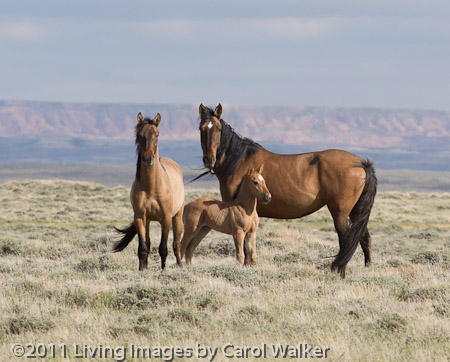
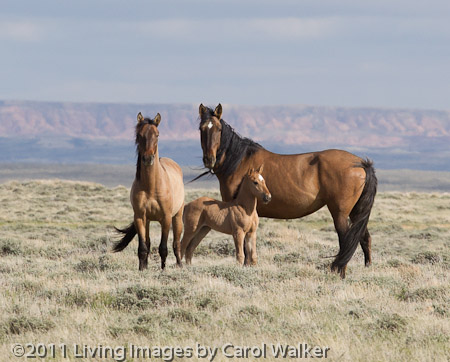
Mare, foal and yearling in Great Divide Basin - now at risk
Last week I headed to Rock Springs, Wyoming so that I could spend time with two wild horse herds that the Bureau of Land Management plans to decimate this summer: White Mountain and Great Divide Basin. It had been 4 years since I had visited these two herd areas, and I wasn’t sure what to expect. Knowing that the White Mountain Roundup is planned for the beginning of July, I have been very concerned about this being during the height of foaling season, putting young foals and very pregnant mares at risk of injury and death. Sure enough, at the very end of May I saw very few foals and many heavily pregnant mares, so there is no possible way that the BLM can convince me that there will not be still many heavily pregnant mares and many 1 month old or younger foals at the time of the roundup. The Wyoming BLM has always said they do not roundup during foaling season – this year is obviously an exception.
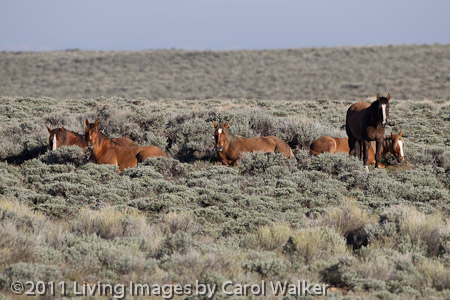
A family band taking a mid-morning nap in White Mountain
My first day at White Mountain I went to the more remote part of the herd area, where there had been hundreds of horses 4 years ago, and only saw one horse. When I headed back through the more accessible “loop tour” area I saw about 50 horses, in 12 different bands – but very few foals. The horses in this area area used to visitors, and were not concerned about my presence.
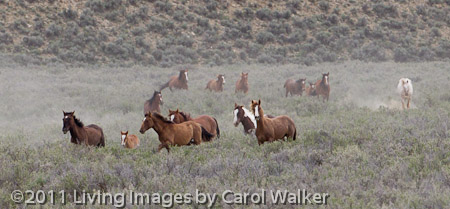
White Mountain horses running for water in the late afternoon
When I went back 2 days later, I happened to stop at the bottom of a gully, and had the amazing experience of watching about 50 horses run straight toward me. I figured out as they passed behind my care then stopped about 100 yards afterward that there was a waterhole there.
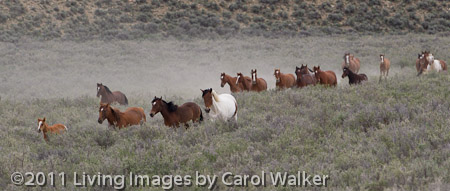
Running for water
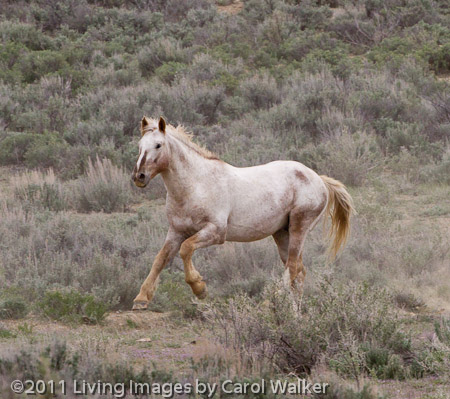
Red Roan stallion for White Mountain
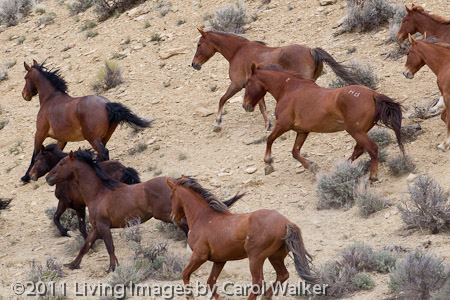
Running behind my vehicle, headed to the waterhole
There were bays and paints and sorrels, blacks, roans, and again, very few foals but one cheeky filly who was having a wonderful time running away from her father, the band stallion.
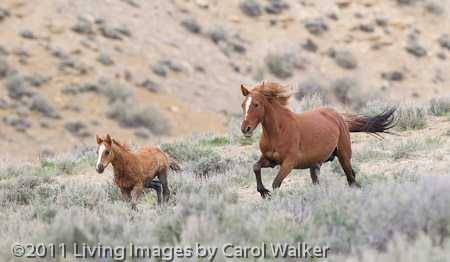
Feisty filly and her mother run
He finally brought her and her mother back to the rest of his band, and all the horses dispersed into their family bands and went in different directions after drinking.
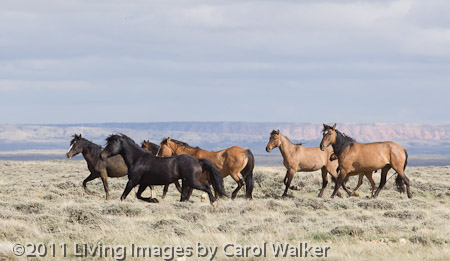
Family Band at Great Divide Basin
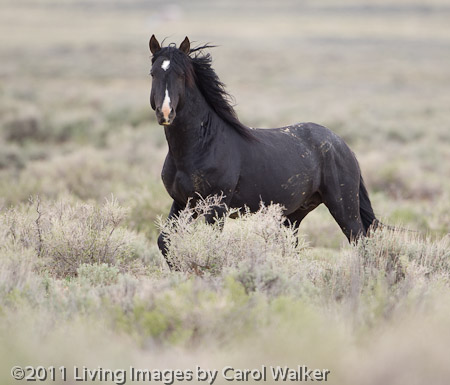
Black Stallion from Great Divide Basin
The other area I visited was Great Divide Basin, and this herd management area is almost 3/4 of a million acres. The plan is to roundup and remove 1225 horses from this area this summer. They also plan to use fertility control on the mares and adjust the sex ratio of the remaining horses to 60% stallions and 40% mares.

A big group of horses at a distance, including many families
The area is vast, and the roads are few. I spent 2 1/2 days driving the roads looking for horses, and was able to get close to about 6 bands, and saw a large group of approximately 70 horses in about 10 or more bands at a far distance through binoculars. Again, I saw very few foals – meaning foaling season has not yet hit its peak at the end of May.
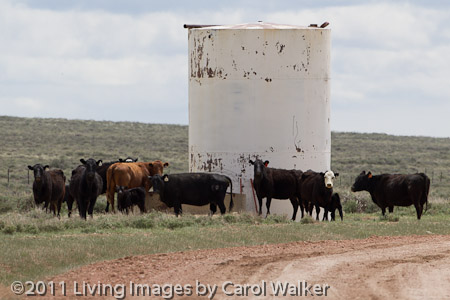
Cattle were prevalent in all 3 herd areas
One thing that is apparent from visiting these herd areas is that Wyoming is not in a drought. The herd areas are greener than I have ever seen them, and water is plentiful. So are cattle. If I had gone with the purpose of photographing cattle, I would have been very successful.
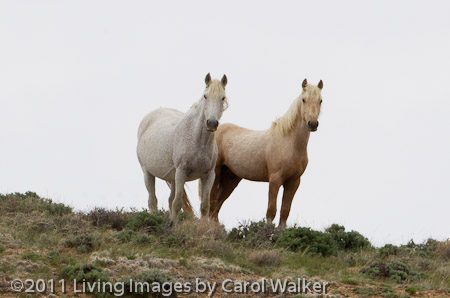
The palomino yearling and his mother
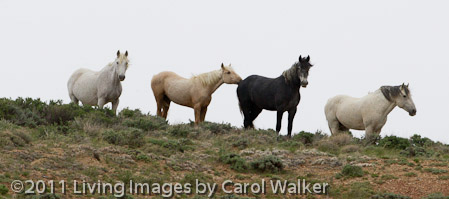
This family band is one of the very few still intact in Adobe Town
When I looked at the weather forecast for the next several days, I decided to leave and go to the Adobe Town Herd Area, my first trip since the roundup and removal of 2100 horses last October and November. I went first to the area where my favorite little band hangs out. They were lucky enough to have missed being captured, and they were still there, and the palomino colt has become a stunning yearling. There were also hundreds of cattle.
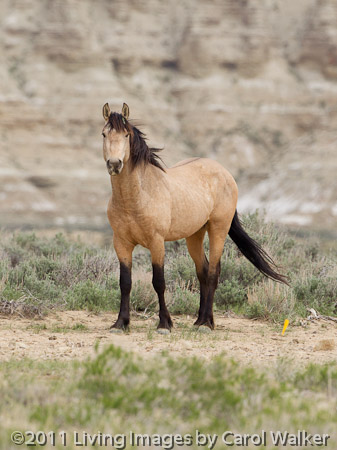
Buckskin bachelor in Adobe Town
I continued on to the little valley where I had spent time with many bands of horses before the roundup. I was excited to see fresh signs of horses as I drove – the stud piles along the road are a sure sign that horses are in the area.
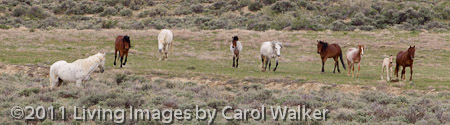
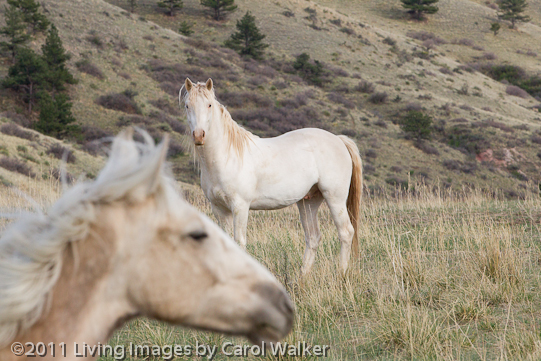
Family band with two stallions, the white snorting stallion looks over at them
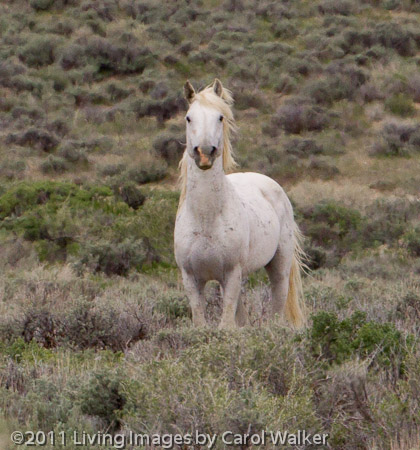
With no family of his own, he acts as a sentry
I first saw a band near an oil and gas pad, and several of them were lying down taking a nap. There were several mares, one foal, and curiously, two stallions. The colors of horses in this area a re very distinct from the White Mountain and Divide Basin horses – here there is a predominance of grays. When I got out of may car with my camera, and old gray stallion who was nearby started snorting. And snorting, and snorting. He was making sure that no one missed my presence in the area. It was funny, except he got all the horses in that band up and running away. I continued driving, and saw what I thought were family bands. As I stopped and got my binoculars out, I started realizing that these were not families that included a stallion, mares, foals and youngsters, but these were in fact small groups of bachelor stallions.
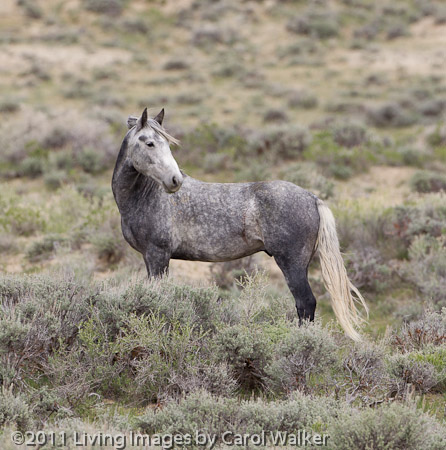
Another beautiful gray bachelor stallion
There were many stallions by themselves, I counted 12, and at least 8 groups of 3 or more bachelors. There was a distinctive group of 3 pure white stallions who were grazing together who captured my attention. These stallions were at least 10 years old – and yet no mares.
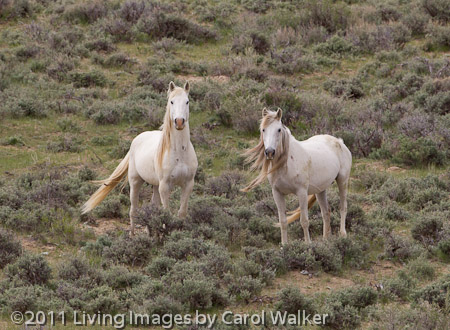
Two Gray bachelors
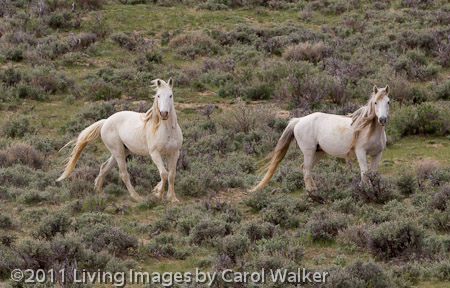
Two gray bachelors
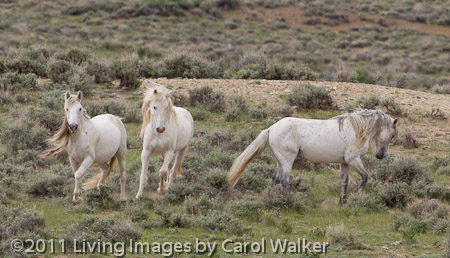
All 3 gray bachelor stallions
Then I saw a young 4 year old stallion with one mare and a foal. The mare looked very nervous, as well she might. Normally a stallion his age would never have a chance having a mare, but with the disruption of the roundup, somehow he had one that he was not looking after very closely.
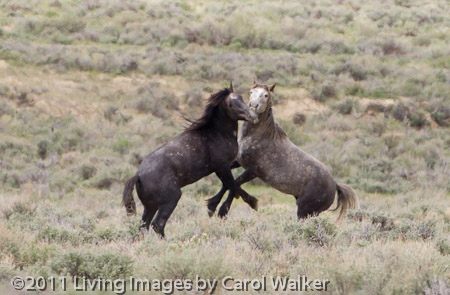
The young gray stallions plays with the intruder
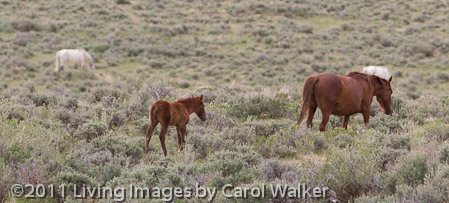
The young gray stallion's mare and foal move off, as he plays
As another young stallion approached, instead of challenging him, the young stud started playing with him as the mare moved further and further away. He finally realized she was moving off, and chased her back. I do not imagine that he will keep her for very long, and she and the baby will suffer for his inexperience and for the overwhelming lack of mares in the area.
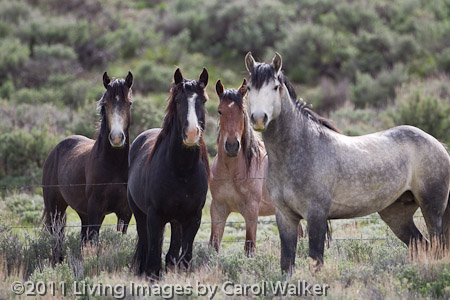
More bachelor stallions
Over 2 days I drove through 1/3 of the Adobe Town Herd Management area, and kept seeing more and more bachelor stallions. A weather front moved in, making roads impassable, so I headed home with a heavy heart. Small consolation that the area is so green this year – I kept thinking about how those 2100 horses in holding facilities would have loved all that green grass. And I remember a conversation I had with a BLM staff member 4 years ago before the 2007 Salt Wells roundup. He said “In 4 years Carol, there will be just as many horses, it will all be the same as it was.” But it is not, and it never will be.
The Adobe Town and Salt Wells Creek mares that were returned to the herd areas after the roundup were all treated with birth control. The sex ratio of the herds were skewed, with the EA suggesting 60% stallions to 40% mares, but the actual numbers once the horses were released worked out to about 66% stallions and 33% mares. This crude, untested, overkill method of birth control rips the very fabric of wild horse society into shreds. Family is the foundation of wild horse society, and producing an overabundance of stallions will lead to fighting and strife for the stallions and stress and instability for mares and foals. It will also make the herd unable to sustain genetic viability in the longer term. This is what they propose to do to the White Mountain, Little Colorado and Great Divide Basin Herds.
There is still time to make your feelings known to the BLM about their proposal for Great Divide Basin. Here is the link to the Environmental Assessment and the address to send your comments – please comment by June 20: http://www.blm.gov/wy/st/en/info/news_room/2011/may/18rsfo-divide.html
Here is a new link posted by the American Wild Horse Preservation Campaign where you can take action quickly:
http://org2.democracyinaction.org/o/6931/p/dia/action/public/?action_KEY=7102
The wild horses of Wyoming are depending upon you.
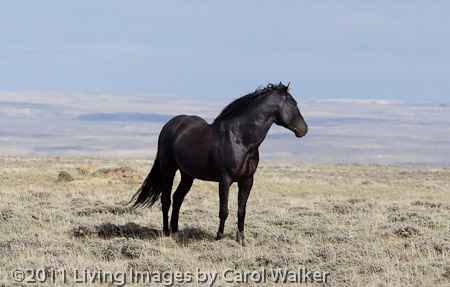
Great Divide Basin stallion - his freedom soon to become just a memory?
39 Comments
Beautiful photos, amazing horses. Thank you for sharing this with us and it breaks my heart to think these wonderful animals may/will be loosing their freedom.
These are more than beautiful images.These are the living , breathing horse population of Wyoming.These images should not become a memorial to “what was”, ahen we as American’s have the ability to preserve our natural resources and wildlife species.Yes, the Mustang is a native of America, long before man arrived, the horse roamed the earth. help preserve our Western heritage and its native inhabitants…Abobve are listed some of the websites to help you join and help keep these magnificent horses free. Thank you, To Crystal walker, for your beautiful documentation, and the American public, who DO care, and are doing their very best to help America’s Mustangs.Together we stand. Sincerely, Tatiana Roveda, Jackson, New Jersey
I am taking a bold stand for the life and restoration of God’s creatures through daily prayer! Knowing God loves his creation and will stand steadfast to protect them! Warrior Angels of love and protection stand all around each one. What man attempts to destroy…God will bring to glorious fruitation!!! With God all things are possible….save all the remaining herds Lord!!!!!Victory reigns!!!!
Fine portraits of these magnificent free spirits in horse form, Carol. Good plea to stop the outrageous roundups and reproductive tinkering. I will protest this.
In the picture captioned “Running behind my vehicle, headed to the waterhole”, there is a horse with Hd branded on the left rump and a “Z” or “2” on the left neck. What is the significance of these brands? and is this horse a mustang?
You are right those are not BLM brands – must be a horse someone turned out into the horse area.
Those two 3½-inch freeze-brands are BLM’s way of tracking which mares have received fertility control treatment. This is referenced in the fourth bullet-point in Appendix III “Standard Operating Procedures for Fertility Control Treatment” on pdf-page 50 of the Great Divide Basin EA Spayed mares get an “S,” which is referenced in Appendix VII “Standard Operating Procedures for Spaying Mares” on pdf-page 67 of the EA, third bullet-point UP from the bottom.
In case you wish to verify right now: http://www.blm.gov/pgdata/etc/medialib/blm/wy/information/NEPA/rsfodocs/divide_basin/2011.Par.26824.File.dat/ea.pdf.
Some offices use two 4-inch letters and add more letters each subsequent time the mares are inoculated with PZP. The obvious purpose is to make it easy for BLM to spot treated mares from above — when doing aerial inventories and roundups. I have registered my objections to this disfigurement — the huge letters are merely for BLM’s convenience while such blemishes will diminish the chances of these fillies and mares being adopted and will ruin the wilderness experience for eco-tourists seeking to view mustangs in their natural state.
Thank you for your field work and for sharing your documentation. This important information, based on recent observations, will help in responding to the EA.
THIS IS SO HORRIBLE. THIS HAS GOT TO BE STOPPED. WHAT IS WRONG WITH THE CRAZY PEOPLE OF THIS WORLD?? THE CATTLEMAN ARE SO GREEDY !! THERE IS PLENTY OF ROOM OUT THERE FOR BOTH. I DO PRAY THAT THIS ROUND UP WILL BE HALTED !!
Beautiful photographs. So sick, government and special interest corruption making such a sick mess of God’s creation.
Thank you for doing this. It makes me ill. Literally.
Beautiful piece! Lets hope they fire Ken Salazar and stop the madness! Love to Cloud and friends!
Ohh Carol..
God Bless you for bringing us these Wild One’s faces and story..
How much more can they take? We know the answer and my heart along with yours so many others is just broken.
They are all in such healthy condition, the ranges in Wyoming and here @ home.. (Colorado) 🙂 are just green.. Even Ginger’s video of Cloud’s B-day.. The Pryor’s had such a hard winter and they look amazing.. Why can’t they give them a break.. *sigh*
Thank you Carol. It had to have been a tough trip to make and to leave them, knowing what’s coming soon.
xoxo
Stunning photos! It’s hard to imagine that the BLM is attempting to destroy this symbol of American Freedom! It has been years since I have visited Wyoming but maybe it’s time again, your photos inspire me.
Thabsk Carol for shhring your beautuful photos. I will share this right now and I do hope BLM get to their senses…//Marie
Trying to spread the word, I blogged about this with links to here. I also posted one of your pics, with credit to you of course. Hope that is ok. Thanks for being such an amazing ally to the wild horses.
So Sad about the BML 🙁 I am passing this on to all my horse friends.
Those white ‘bachelors’ are just GORGEOUS!
Such bittersweet words. How could anyone with any human compassion look at these beautiful animals, really look deep into their eyes and subject them to the horrors of roundups? Oh yeah, it’s the BLM, how incredibly stupid of me.
hi carol…your photos are beautiful. last year i did the same thing you did in july at twin peaks. i went out camping to take photos just before the round-ups started and noticed the same things you did. pregnant mares, tiny foals, too many bachelors and lone stallions (and this was before the round-ups started!) and was so worried about them taking too many, which they did, and taking them too young and or pregnant, which they did. the results were horrible and litchfield was full of sick babies, mares who had lost them foaling and all sorts of other bad things. isn’t it sad that i can see and experiance the very same things you did and i’m hundreds of miles away? i also like you, have a young one that i adopted from this gather. he’s in many ways and wonderful consolation, but my hear still hurts.
It is not good enough that we all just feel sad for the horses. If everyone on Facebook, Twitter and the blog rolls would write to President Obama, Ken Salazar and members of Congress stating emphatically that you do not want your tax dollars spent this way AND you feel strongly enough to vote people out of office who continue to let it happen, only then will it change. I know it gets discouraging to constantly write emails and make calls but it does in the end of the day work. Politicians only care about losing their seat, very few of them really care about wild horses and burros or any other form of wildlife. It is up to us to change their minds and make them care what we want. Just like the Cattlemens Association.
Wonderful pictures Carol. Thanks for sharing. So tired of seeing how people consider animals wild and domestic just throw aways. Human insensitivity has become epidemic. I will share this info with others and know some who will also write the BLM to express the indignant and inhumane treatment of these wonderful creatures. I own two horses of my own and they are in pasture year round with the care of my sister and myself. We provide ample food during the winters months and they graze during the spring, summer and fall. I wish more people would put themselves in the place of these animals and reach into the depths of their hearts and give them the chance they deserve. ANIMALS are NOT throw-away.
I live in PA and will be traveling out to Wyoming this month. Would love some bullet points to include in a letter I plan to hand deliver to the Rock Springs Field Office. I am working very hard to educate people in my area about the plight of these horses.
Thanks,
Robin
Dear Robin,
You are welcome to use any information I have posted in my blog, and also The American Wild Horse Preservation Campaign, http://www.wildhorsepreservation.com is going to be posting an alert in the next couple of days with even more information
Dear Robin,
Here is the link to the AWHPC alert that allows people to take action and comment on the Great Divide Basin EA, comments due June 20:
http://org2.democracyinaction.org/o/6931/p/dia/action/public/?action_KEY=7102
Beautiful photos but how sad that humans are interfering with nature yet again no wonder the horses are so nervous i would love to see them but it would make me so sad to know how badly they are treated when they are being rouded up. i tried to sign the petition but as i am in the uk it wouldnt accept my postcode.
Those are some beautiful horses! We need to save our horses.
Thanks for bringing this issue to light. You have a beautiful body of work – in your written and photographic documentation. I have send my comments against this roundup to the Great Divide Basin EA.
[…] A copy of the complaint is available upon request. Photographs of the White Mountain and Little Colorado wild horses can be found here. […]
[…] A copy of the complaint is available upon request. Photographs of the White Mountain and Little Colorado wild horses can be found here. […]
[…] Copies of the expert declarations, TRO and complaint are available upon request. Photographs of the White Mountain and Little Colorado wild horses can be found here. […]
BLM
Please stop the decimation of the wild horse. I have seen the gathered horses and have adopted a yearling colt, now gelded. Just one of these gentle and beautiful animals saved is not enough. Some reps from experts on the rangeland, ranchers, HSUSA, land use specialists, and wild horse advocates need to meet with an arbitration and planning board to find a fair and equitable way to manage the wild horse population.
Margo Phipps Alden, California
[…] things that are more beautiful than a free spirit. Today, I’d like to direct you to the blog, Wild Hoofbeats, written by Carol Walker. Carol has made it her life’s work to try to protect the herds of […]
My husband and I went to the meeting in Rock Springs and the plans they have for the wild horses is sickening to say the least. How can they sleep at night? I tried hard to give them the benefit of the doubt and for what? The only sincerity is that they are sincerely working to do this wonderful animal in to extinction. It doesn’t even bother them that what they are doing is against the law.
Just what has this country come to anyway?
When is the government going to keep there hands to themselves when it comes to wild horses? The lengths they Are going to make them extinct is appalling!
Let’s round up Salzar and all his henchmen and do them th same way.
The Wild Free-Roaming Horses and Burros Act of 1971
(Public Law 92-195)
To require the protection, management, and control of wild free- roaming horses and burros on public lands. Be it enacted by the Senate and House of Representatives of the United States of America in Congress assembled, That Congress finds and declares that wild free-roaming horses and burros are living symbols of the historic and pioneer spirit of the West; that they contribute to the diversity of life forms within the Nation and enrich the lives of the American people; and that these horses and burros are fast disappearing from the American scene. It is the policy of Congress that wild free-roaming horses and burros shall be protected from capture, branding, harassment, or death; and to accomplish this they are to be considered in the area where presently found, as an integral part of the natural system of the public lands.
Sec. 2. As used in this Act-
“Secretary” means the Secretary of the Interior when used in connection with public lands administered by him through the Bureau of Land Management and the Secretary of Agriculture in connection with public lands administered by him through the Forest Service;
“wild free-roaming horses and burros” means all unbranded and unclaimed horses and burros on public lands of the United States;
“range” means the amount of land necessary to sustain an existing herd or herds of wild free-roaming horses and burros, which does not exceed their known territorial limits, and which is devoted principally but not necessarily exclusively to their welfare in keeping with the multiple-use management concept for the public lands;
“herd” means one or more stallions and his mares; and
“public lands” means any lands administered by the Secretary of the Interior through the Bureau of Land Management or by the Secretary of Agriculture through the Forest Service.
“excess animals” means wild free-roaming horses or burros (1) which have been removed from an area by the Secretary pursuant to application law or, (2) which must be removed from an area in order to preserve and maintain a thriving natural ecological balance and multiple-use relationship in that area.
Sec. 3.
All wild free-roaming horses and burros are hereby declared to be under the jurisdiction of the Secretary for the purpose of management and protection in accordance with the provisions of this Act. The Secretary is authorized and directed to protect and manage wild free-roaming horses and burros as components of the public lands, and he may designate and maintain specific ranges on public lands as sanctuaries for their protection and preservation, where the Secretary after consultation with the wildlife agency of the State wherein any such range is proposed and with the Advisory Board established in section 7 of this Act deems such action desirable. The Secretary shall manage wild free-roaming horses and burros in a manner that is designed to achieve and maintain a thriving natural ecological balance on the public lands. He shall consider the recommendations of qualified scientists in the field of biology and ecology, some of whom shall be independent of both Federal and State agencies and may include members of the Advisory Board established in section 7 of this Act. All management activities shall be at the minimal feasible level and shall be carried out in consultation with the wildlife agency of the State wherein such lands are located in order to protect the natural ecological balance of all wildlife species which inhabit such lands, particularly endangered wildlife species. Any adjustments in forage allocations on any such lands shall take into consideration the needs of other wildlife species which inhabit such lands.
The Secretary shall maintain a current inventory of wild free-roaming horses and burros on given areas of the public lands. The purpose of such inventory shall be to: make determinations as to whether and where an overpopulation exists and whether action should be taken to remove excess animals; determine appropriate management levels of wild free-roaming horses and burros on these areas of the public lands; and determine whether appropriate management levels should be achieved by the removal or destruction of excess animals, or other options (such as sterilization, or natural controls on population levels). In making such determinations the Secretary shall consult with the United States Fish and Wildlife Service, wildlife agencies of the State or States wherein wild free-roaming horses and burros are located, such individuals independent of Federal and State government as have been recommended by the National Academy of Sciences, and such other individuals whom he determines have scientific expertise and special knowledge of wild horse and burro protection, wild-life management and animal husbandry as related to rangeland management.
Where the Secretary determines on the basis of (i) the current inventory of lands within his jurisdiction; (ii) information contained in any land use planning completed pursuant to section 202 of the Federal Land Policy and Management Act of 1976; (iii) information contained in court ordered environmental impact statements as defined in section 2 of the Public Rangelands Improvement Act of 1978; and (iv) such additional information as becomes available to him from time to time, including that information developed in the research study mandated by this section, or in the absence of the information contained in (i-iv) above on the basis of all information currently available to him, that an overpopulation exists on a given area of the public lands and that action is necessary to remove excess animals, he shall immediately remove excess animals from the range so as to achieve appropriate management levels. Such action shall be taken, in the following order and priority, until all excess animals have been removed so as to restore a thriving natural ecological balance to the range, and protect the range from the deterioration associated with overpopulation:
The Secretary shall order old, sick, or lame animals to be destroyed in the most humane manner possible;
The Secretary shall cause such number of additional excess wild free-roaming horses and burros to be humanely captured and removed for private maintenance and care for which he determines an adoption demand exists by qualified individuals, and for which he determines he can assure humane treatment and care (including proper transportation, feeding, and handling): Provided, That, not more than four animals may be adopted per year by any individual unless the Secretary determines in writing that such individual is capable of humanely caring for more than four animals, including the transportation of such animals by the adopting party; and [PRIA 10/25/1978]
The Secretary shall cause additional excess wild free roaming horses and burros for which an adoption demand by qualified individuals does not exist to be destroyed in the most humane and cost efficient manner possible.
For the purpose of furthering knowledge of wild horse and burro population dynamics and their interrelationship with wildlife, forage and water resources, and assisting him in making his determination as to what constitutes excess animals, the Secretary shall contract for a research study of such animals with such individuals independent of Federal and State government as may be recommended by the National Academy of Sciences for having scientific expertise and special knowledge of wild horse and burro protection, wildlife management and animal husbandry as related to rangeland management. The terms and outline of such research study shall be determined by a redesign panel to be appointed by the President of the National Academy of Sciences. Such study shall be completed and submitted by the Secretary to the Senate and House of Representatives on or before January 1, 1983.
Where excess animals have been transferred to a qualified individual for adoption and private maintenance pursuant to this Act and the Secretary determines that such individual has provided humane conditions, treatment and care for such animal or animals for a period of one year, the Secretary is authorized upon application by the transferee to grant title to not more than four animals to the transferee at the end of the one-year period.
Wild free-roaming horses and burros or their remains shall lose their status as wild free-roaming horses or burros and shall no longer be considered as falling within the purview of this Act- (1) upon passage of title pursuant to subsection (c) except for the limitation of subsection (c)(1) of this section, or (2) if they have been transferred for private maintenance or adoption pursuant to this Act and die of natural causes before passage of title; or (3) upon destruction by the Secretary or his designee pursuant to subsection (b) of this section; or (4) if they die of natural causes on the public lands or on private lands where maintained thereon pursuant to section 4 and disposal is authorized by the Secretary or his designee; or (5) upon destruction or death for purposes of or incident to the program authorized in section 3 of this Act; Provided, That no wild free-roaming horse or burro or its remains may be sold or transferred for consideration for processing into commercial products.
Sec. 4. If wild free-roaming horses or burros stray from public lands onto privately owned land, the owners of such land may inform the nearest Federal marshall or agent of the Secretary, who shall arrange to have the animals removed. In no event shall such wild free-roaming horses and burros be destroyed except by the agents of the Secretary. Nothing in this section shall be construed to prohibit a private landowner from maintaining wild free-roaming horses or burros on his private lands, or lands leased from the Government, if he does so in a manner that protects them from harassment, and if the animals were not willfully removed or enticed from the public lands. Any individuals who maintain such wild free-roaming horses and burros on their private lands or lands leased from the Government shall notify the appropriate agent of the Secretary and supply him with a reasonable approximation of the number of animals so maintained.
Sec. 5. A person claiming ownership of a horse or burro on the public lands shall be entitled to recover it only if recovery is permissible under the branding and estray laws of the State in which the animal is found.
Sec. 6. The Secretary is authorized to enter into cooperative agreements with other landowners and with the State and local governmental agencies and may issue such regulations as he deems necessary for the furtherance of the purposes of this Act.
Sec. 7. The Secretary of the Interior and the Secretary of Agriculture are authorized and directed to appoint a joint advisory board of not more than nine members to advise them on any matter relating to wild free-roaming horses and burros and their management and protection. They shall select as advisers persons who are not employees of the Federal or State Governments and whom they deem to have special knowledge about protection of horses and burros, management of wildlife, animal husbandry, or natural resources management. Members of this board shall not receive reimbursement except for travel and other expenditures necessary in connection with their services.
Sec. 8.
Any person who-
willfully removes or attempts to remove a wild free- roaming horse or burro from the public lands, without authority from the Secretary, or
converts a wild free-roaming horse or burro to private use, without authority from the Secretary, or
maliciously causes the death or harassment of any wild free-roaming horse or burro, or
processes or permits to be processed into commercial products the remains of a wild free-roaming horse or burro, or
sells, directly or indirectly, a wild free-roaming horse or burro maintained on private or leased land pursuant to section 4 of this Act, or the remains thereof, or
willfully violates a regulation issued pursuant to this Act, shall be subject to a fine of not more than $2,000, or imprisonment for not more than one year, or both. Any person so charged with such violation by the Secretary may be tried and sentenced by any United States commissioner or magistrate designated for that purpose by the court by which he was appointed, in the same manner and subject to the same conditions as provided for in section 3401, title 18, United States Code.
Any employee designated by the Secretary of the Interior or the Secretary of Agriculture shall have power, without warrant, to arrest any person committing in the presence of such employee a violation of this Act or any regulation made pursuant thereto, and to take such person immediately for examination or trail before an officer or court of competent jurisdiction, and shall have power to execute any warrant or other process issued by an officer or court of competent jurisdiction to enforce the provisions of this Act or regulations made pursuant thereto. Any judge of a court established under the laws of the United States, or any United States magistrate may, within his respective jurisdiction, upon proper oath or affirmation showing probable cause, issue warrants in all such cases.
Sec. 9. In administering this Act, the Secretary may use or contract for the use of helicopters or, for the purpose of transporting captured animals, motor vehicles. Such use shall be undertaken only after a public hearing and under the direct supervision of the Secretary or of a duly authorized official or employee of the Department. The provisions of subsection (a) of the Act of September 8, 1959 (73 Stat. 470; 18 U.S.C. 47(a)) shall not be applicable to such use. Such use shall be in accordance with humane procedures prescribed by the Secretary.
Sec. 10. Nothing in this Act shall be construed to authorize the Secretary to relocate wild free-roaming horses or burros to areas of the public lands where they do not presently exist.
Sec. 11. After the expiration of thirty calendar months following the date of enactment of this Act, and every twenty-four calendar months thereafter, the Secretaries of the Interior and Agriculture will submit to Congress a joint report on the administration of this Act, including a summary of enforcement and/or other actions taken thereunder, costs, and such recommendations for legislative or other actions he might deem appropriate.
The Secretary of the Interior and the Secretary of Agriculture shall consult with respect to the implementation and enforcement of this Act and to the maximum feasible extent coordinate the activities of their respective departments and in the implementation and enforcement of this Act. The Secretaries are authorized and directed to undertake those studies of the habits of wild free-roaming horses and burros that they may deem necessary in order to carry out the provisions of this Act.
This is 2014. I hope at least some of the horses are still there when I take a road trip next summer to southern Wyoming. I plan to do a very basic, unofficial study.
Dear Carol,
Your photos are wonderful. I am an artist, painting in oils and I too want to help wild horses remain free. I took several trips to see then from 2008-2011. All the paintings I sell of the wild horses I give half of the proceeds to the purchasers choice of Wild Horse funds. I just sold another painting this month, that you can see on my website, it is called “Wild and Free” of horse in Wyoming. The purchaser will be able to write a check for $2400 directly to the Horse Fund in Wyoming, tax deductible for her and enjoying being able to help the wild horses there while owning a painting of them.
I am hoping you would like to collaborate with your photos of the white stallions for me to do another painting of horse that would help herds in that area. If I could use the three images and regroup them for a painting, I believe they would make a good image to raise money more money. We could promote together.
PLease feel free to call me, 561 324 0100, Laurie SNow Hein
Dear Laurie,
I think that is great that you want to help the wild horses. However, I do not allow other artists to use my work as a reference. I encourage you to use the images you took on your own trips to do your paintings.
[…] homes. Since then, I’ve had to do a bit more research to understand the situation better, and here is more information. Also, here are some pictures of where Rocío was probably […]
Hy, I just acquired a bay gelding from a lady moving from fl. to Vermont. He,s a goodlooking guy capured from Salt Wells near Rock Springs, 10/1/2014. Just wonted you to know that he has found a good home with plenty of good pasture and water and will be taken good care of and will spend the rest of his life here.
That is wonderful Bob, thank you for letting me know.