
The Bitter End: The Adobe Town Roundup
August 11, 2025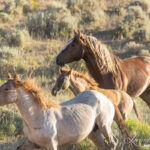
Roundups to Zero Out Wyoming Checkerboard Wild Horse Herds Stopped for Now
September 11, 2025

What does it really take to zero out a wild horse herd? In this episode, I take you behind the scenes of the Adobe Town roundup, where the BLM captured far more wild horses than they should have, pushing this herd dangerously close to being wiped out. Though their target was met, the process that led to this moment was far from transparent or humane.
I spent five days observing the roundup, witnessing heartbreaking moments: foals running from helicopters, families being separated, and a foal found dead after becoming separated from its mother during the roundup. The BLM’s refusal to take responsibility for this loss and their decision to exclude certain deaths from the official count raises troubling questions about their practices. The herd numbers are artificially inflated by including foals in the count—against their own guidelines—which means they’ve likely taken this herd far below the low appropriate management level of 259 horses.
While the roundup is now over, the real damage is done. The BLM has not confirmed whether they will conduct a post-roundup count, and with horses being sent to facilities where public access is restricted, the fate of these horses remains uncertain. The future of these wild horses hangs in the balance, and we have to keep fighting to make sure they are protected.
Subscribe to my blog to get more information on how you can help America’s wild horses.
What You’ll Learn from this Episode:
- Why the BLM’s method of counting foals leads to over-removal and risks zeroing out herds.
- How roundups during foaling season lead to preventable deaths that don’t appear in official reports.
- What it’s like to witness a roundup when public access is limited.
- Where the captured horses go and why the process is kept out of the public eye.
- Why post-roundup population counts are essential for the survival of these herds.
- How the 2023 resource management plan revision reduced Adobe Town’s protected land.
- The impact of staffing shortages on the BLM’s adoption process and long-term horse care.
Listen to the Full Episode:
Featured on the Show:
- Subscribe to my blog to get more information on how you can help America’s wild horses.
- Follow along on Facebook and Instagram!
- Living Images by Carol Walker
- Follow my blog to get updates on the coming roundup this summer: Wild Hoofbeats Blog
- Wild Hoofbeats: America’s Vanishing Wild Horses by Carol Walker
- 2025 Adobe Town Herd Management Area Wild Horse Gather
Welcome to the Freedom For Wild Horses podcast, the place to find out about wild horses in the American West and what you can do to help them stay wild and free. If you love wildlife, wild horses, and the freedom that they stand for, this show is for you. I’m your host, Carol Walker. Let’s get started.
First, a brief update on what’s going on with our 10th Circuit Court case. Our case stays in the 10th Circuit Court for 52 days, and then it goes back to the Wyoming District Court. It may be this winter or spring of 2026 before any decision is made there. In the meantime, the BLM has postponed the zero-out roundup for Saltwells Creek and 1/3 of Adobe Town from August 25th to October at the earliest. But the BLM has not produced a gather schedule with dates for fiscal year 2026 yet. This starts October 1st, 2025. So it’s a waiting game once again. I think any delay is a very good thing for the horses.
The Adobe Town Herd Management Area is now 348,000 acres and managed entirely by the Rawlins BLM field office. The remaining approximately 150,000 acres that used to be part of the herd management area was carved off in the resource management plan revision in 2023 to try to preemptively keep wild horses off the soon-to-be zeroed-out Saltwells Creek.
So this portion of Adobe Town was also to be zeroed out like a buffer, and the remaining herd management area had its appropriate management level adjusted down, of course, to 259 at the low and 536 at the high, wild horses.
The Adobe Town roundup for the portion of Adobe Town managed by the Rawlins BLM office ended on July 31st, 2025. I was there for days 3, 4, 5, and for the last two days, the bitter end. Lasting 17 days total, the BLM captured 1,677 wild horses, and since their goal was 1,675, they released two stallions at the end. The BLM was far more concerned with getting their numbers than with being concerned about whether or not they may take too many horses, possibly taking the herd way below the low appropriate management level of 259.
I repeatedly asked if they were going to do a count at the end to ensure that they did not take too many horses, as was done last August in the White Mountain herd roundup, when they left 79 horses instead of 205. This was a virtual zero out of the herd.
This was a very bad time to round up wild horses in Wyoming. It’s hot, and foaling season is not over. There were dozens of very small foals that I saw running, foals that should never be running from a helicopter. Some died, and I am certain that many more will have died in the months following the roundup. Because the contractor, Samson, was in such a hurry and shipping all the horses to short-term holding within a day of their capture, those deaths will not be counted in the gather-related deaths. A Freedom of Information Act request will likely be needed to find out how many died after the roundup. It’s likely there will be dozens of deaths.
Foals died from capture myopathy, which really means that they were run to death. On the second-to-last day of the roundup, a blaze-faced sorrel foal fell behind its mother by about a mile. The wranglers went out to capture it, and it was supposedly reunited with its mother and given electrolytes, and seen by a vet, but was found dead the next morning. Such needless suffering. This is a common occurrence for roundups in July because it is exactly the wrong time of year to do this.
On July 21st, the BLM took a foal death out of the totals for some unknown reason. Clearly, having low numbers of deaths is the priority. I asked about this, but was not given a reason or reply. In the gather report on the website of the BLM, it says, “A deceased bay foal was determined not to be part of gather operations. The matter is under investigation. Death not included in total numbers.”
The BLM finally responded to me this morning about the foal. “In response to your inquiry about the foal death on July 21st, the Bureau of Land Management has received clarification from the incident commander who was overseeing the gather at this time. The foal, a bay of unknown sex, was found deceased in the first trap pen upon the gather crew’s arrival at the trap site that morning. The foal was not present in the trap pen when the final group of horses was transported to the temporary holding facility on the afternoon of July 20th. Based on available information, it is believed the foal was likely an uncaptured animal that remained in the area and was subsequently placed in the trap pen by a member of the public. Following this incident, Bureau of Land Management law enforcement officers began placing cameras at trap sites to monitor for any potential tampering after hours.”
This is, without question, the most bizarre response I have ever been given by the BLM. The most likely explanation is that the foal, who had been left behind, showed up at the trap and went in and died. Small foals need to nurse every 3 to 4 hours. At the Sand Wash Basin roundup, foals showed up at the trap by themselves again and again. This blaming of the public with absolutely no evidence seems to be a very extreme way to avoid any responsibility for the foal’s death.
The BLM used an infrared survey to come up with the numbers of wild horses in the herd and their targeted number for removal, and they included an estimated 20% foal crop to arrive at their numbers. But by BLM’s own guidelines in their Wild Horse and Burro Handbook, they are only supposed to include adult horses, not foals, and by doing this have overestimated the herd size. Their target goal of 1,675 wild horses removed would most likely take the herd far below the appropriate management level of 259 and effectively zero out the herd management area. The BLM was completely non-responsive to queries about this.
Over half of the horses captured were in the far southern part of the range near the border of Colorado, around Powder Wash. I was frankly astonished that they were able to catch as many horses as they did. Then I remembered that in 2021, they did not capture horses in this area. The last time was in the roundup of 2017, and I can only think that this was a pocket area that had not been as horribly affected by the killing winter of 2022 to 2023, when so many elk, deer, pronghorn, and horses died.
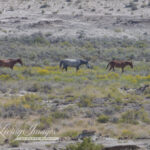
During the last two days of the roundup, the observation location was terrible. We were placed a mile and a half from the trap, and because of the brush and terrain and the route the pilot took the horses, they mostly showed up as little dots briefly. We had no view at all of the trap. When our public affairs person, who was with us, tried hard to get a different, closer location where we could see something, we were told no after the helicopter was already flying, and we had no time to get to our bad location. So we climbed a hill and could at least see some of the horses in the distance crossing the road. There is no meaningful observation when we cannot see the trap and can barely make out the horses.
I went to the last opportunity to observe the horses at temporary holding. With the thick tarps covering the pens, it was difficult to see anything, even from on top of a small hill. We could see heads of mares and foals, and only through one lifted flap could we see any of the foals. The horses were crowded incredibly tightly together. No wonder there were wounds on the heads of the stallions and some of the mares.
Unfortunately, the two families we had seen driving in the last day were only 3 miles away, and they were captured immediately. Among these horses were a family I had spent time with on my last trip: a gorgeous older gray stallion, his bay mares, a small bay foal, and small palomino foal. This family and another we saw driving in were the first to be captured.
The BLM called the roundup finished when they captured 677 and told us we could go watch the two stallions they would be releasing. We hurried to get to the trap, and a gray and a buckskin stallion were being released. They approached the open door of the pen cautiously, almost like they did not believe it. Then they slowly trotted out, the lone horses to have survived the roundup and been released back into their home.
Although the Adobe Town roundup for the portion of Adobe Town which is still a herd management area is over, the lasting effect of possibly, likely, taking the herd down below the low appropriate management level of 259 horses will last for many years to come. The BLM needs to do the right thing and immediately do a count. And if they have taken the herd below this level, they need to immediately return horses to their home. Otherwise, they may have left very few horses in the herd, virtually zeroing it out.
The stallions were sent to Wheatland, which is a private facility that does not allow the public in to see the horses. The mares and foals went to Canon City, Colorado, and Rock Springs, Wyoming. It will be spring before any of these horses will be available for adoption. Why? Why does it take so many months to prepare these horses for adoption at three different facilities? What they have to do is draw blood for a Coggins test. Then they need to freeze brand and vaccinate them. The stallions need to be gelded. Canon City and Rock Springs used to be able to do this in 2 to 3 months. Now they are severely understaffed, and adoption is not a priority.
My concern is, what if they are not made available for adoption? If Congress does not include protections against killing, slaughter, or transfer to the fiscal year 2026 budget, the BLM could stop offering horses for adoption. It’s important to keep contacting your senators and representatives for the future and the health, and the well-being, and continued survival of our wild horses.
Thank you for listening to this episode of Freedom for Wild Horses.
Thank you for listening to this episode of Freedom for Wild Horses. If you want to learn more, follow me at www.wildhoofbeats.com for more information and for ways to help America’s wild horses. See you next time.
Enjoy the Show?
- Don’t miss an episode, follow the podcast on Apple Podcasts, Spotify or RSS.
- Leave us a review in Apple Podcasts.
4 Comments
You are always on top of it all as painful as it is to know!
Thanks Carol – I didnt get to this until today (28th) but have kept up with WHE on the many roundups.
The cruelty and lack of knowhow on the part of this government agency and the various contractors just keeps on going year after year. Writing to “my” senators and Repres. is pretty much useless – just get the repetition of the BLM’s own propaganda spit back. Doesnt matter which party they belong to – the only difference if they are Democrats (and they are) they actually do reply. Not an informed & researched reply – just BLM crap.
I have no idea how or if we, the people who do care, can make a change in this to benefit these Wild Horses and the Burros, too. I just dont know. There are so many good people still trying, you are one of them, and its been 50 some years since we got a WHBA and still?
Thanks again, Carol
Thanks
Magnificent animals