

Ep #59: Revisiting Wild Horse Holding Facilities
October 6, 2025
Ep #61: The Lost Horses: It’s Time to Pass the SAFE Act
November 17, 2025
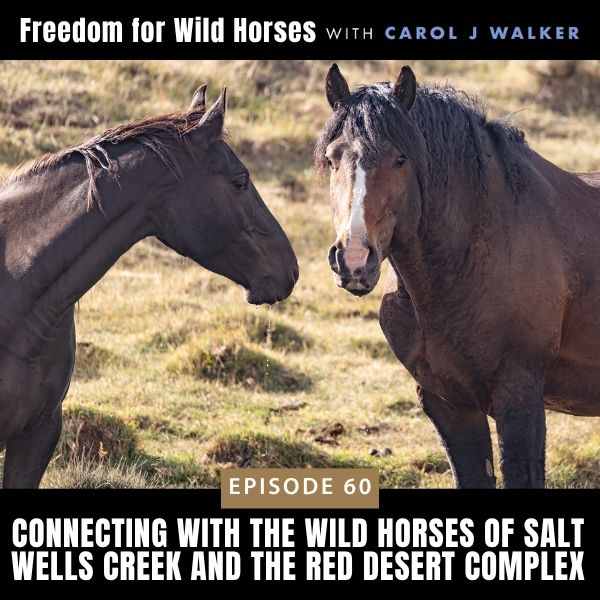
Have you ever wondered what it feels like to connect with wild horses? In this episode, I take you with me on my September journey through Salt Wells Creek and the Red Desert Complex in Wyoming. With the roundup postponed for another season, I was able to spend time among wild horse families who remain free, witnessing their strength, their relationships, and the quiet power that defines life in the high desert.
Throughout this trip, I spent mornings watching families gather near water, stallions keeping watch over their bands, and bachelor groups moving together across the landscape. I saw how the horses interacted with one another, how they approached with curiosity, and how they navigated their world with awareness and resilience.
From early mornings at the springs to quiet moments in the open sage, these encounters offered a chance to observe wild horses living freely in their home ranges. Their movements, their social bonds, and their ability to endure challenges are powerful reminders of what’s at stake in keeping these herds wild.
Subscribe to my blog to get more information on how you can help America’s wild horses.
What You’ll Learn from this Episode:
- How wild horse families reorganize after stallions lose their bands and the surprising new dynamics that form.
- The resilience and healing abilities of wild horses after injuries and harsh winters.
- How bachelor stallions build companionship and support after losing families in roundups.
- The behavioral differences between Salt Wells Creek horses that live in groups and Red Desert horses spread across vast areas.
- How wild horses use subtle communication to maintain harmony within their families.
Listen to the Full Episode:
Featured on the Show:
- Subscribe to my blog to get more information on how you can help America’s wild horses.
- Follow along on Facebook and Instagram!
- Living Images by Carol Walker: Salt Wells Creek | Red Desert Complex
- Follow my blog to get updates: Wild Hoofbeats Blog
- Wild Hoofbeats: America’s Vanishing Wild Horses by Carol Walker
Welcome to the Freedom For Wild Horses podcast, the place to find out about wild horses in the American West and what you can do to help them stay wild and free. If you love wildlife, wild horses, and the freedom that they stand for, this show is for you. I’m your host, Carol Walker. Let’s get started.
In the middle of September, I took my first trip to visit wild horses since the Salt Wells Creek roundup had been put on hold until next summer at the earliest, which was such a tremendous relief. This meant that we and the horses would have some breathing room before the next disaster struck. They were fine for now, and so was I, and it was an extraordinary trip.
I started by going to Rock Springs and heading out to Salt Wells Creek before dawn, which was mercifully later now that the sun was coming up at 7 with the coming of fall. I drove through Maggie Springs and could see several small families in the distance across deep draws. When I came up on top of the hill, then drove down the road, I saw several families of wild horses coming up a hill near a road I had not gone down before.
When I drove down and looked, there were over 70 horses running at the bottom of the hill in a meadow. Some of them then running up the road, including Julian’s band, which has an odd configuration for a wild horse family. Three stallions, a mare, her gray yearling, and Palomino foal. Julian is a cremello curly that I have known for 5 years since he was a foal. Julian stopped and watched the other families, framed by the stormy sky behind him.
Silverado, the stunning silver dapple stallion who had lost his family this summer, was playing with a group of bachelors, and he looked really healthy and strong. And then I was delighted to see that he was back with his family. Wild horses are amazingly resilient, able to heal from wounds that look life-threatening.
One of the highlights of this trip was getting to spend time with the iconic wild curly stallion Bello. I had heard so much about this bay curly stallion with a long white blaze. I followed a friend’s directions to get to a spring, and I saw a family with a big curly stallion in the distance walking toward it. I continued down a two-track, surrounded by sage, and saw the whole family standing on the rocks around the spring getting their morning drink.
At first, I could not see Bello, but saw his big gray curly mare, two black mares, a sorrel, and two foals. And then as the mares moved, I saw Bello. He was big, with beautiful long curls and deep wisdom in his eyes. Being in the presence of such a strong-souled horse took my breath away. It’s very different being in the presence of such a special animal instead of seeing a photograph or a video. His gaze seemed to take me in, and then he was moving, nudging his family to move into the sage, and then they went in a line, and he took up the rear, looking back at me, calm and knowing, protecting his family. It took me some time to recover and drive back to the road.
When I drove north up Aspen Mountain Road, I saw some horses taking a mid-morning nap. As I got closer, I saw Teton stretched out flat on his side, impossible to miss with his loud red pinto markings. His name comes from the markings on his side that look like mountains. The band stallion, Sid, stood above him playing sentinel, and the sorrel mares and foals were napping as well. It was such a peaceful scene. Then Teton rolled up, still lying down, but muzzle resting on the grass.
Nearby, the red roan Valentino was cuddled up with three other bachelors: a buckskin, a very pale buckskin, and a cremello. They were all bachelor stallions. Valentino lost his entire colorful family in the 2021 roundup and suffered a huge wound on his side 2 years ago from fighting with other stallions, which has since healed up, leaving only a long, wicked scar. Teton got to his feet, and he and Sid sniffed each other, squealing a little, then started walking toward the road that leads down to several springs.
I drove down that road and parked, waiting for the 60 or so horses that were now on the move to come down the hill to drink. They started spilling down the hill, and I enjoyed the fall colors of the horses headed to the springs. Teton and Sid guided their family to a quieter part of the springs to stay away from the rest of the horses, especially Valentino and the other bachelors. Once each family drank, they moved up another hill until there were lines of horses crossing it, except for the bachelors who lingered.
On an overcast gray morning with threatening clouds, I spotted Bonfire and his family. This year I’ve seen them almost every day I went out to see the horses. His family is a beautiful rainbow of roans plus one sorrel mare, and Bonfire is a deep liver chestnut curly with long curls in his mane and forelock. He has a star on his forehead and no other white on his body. I watched his foals get up from a nap, and then his mares started to graze. Then Bonfire moved closer to me and we looked into each other’s eyes for what seemed like a long time. He was quiet, unconcerned, but interested. I felt the same way.
Next, I went down a two-track into an area I’d never been before. I looked through my binoculars and spotted Scarface and his family. They were all damp from the rain the night before, and now, waking up from a nap. I’ve known Scarface longer than any other horse out there, having met him as a young bachelor stallion 12 years ago. His black yearling son with a white hourglass marking spread over his face was standing next to him and clacking submissively, reminding me of a goofy young Scarface.
When the magnificent curly stallion Bubba died 3 years ago, Scarface took his family in, including his lovely lead Palomino mare, Sunny, who was pregnant with his last curly foal, the beautiful black curly Sean. He has a short curly mane and curls in his ears and is now 2 years old. I am really hoping he can get the chance to stay in his home and grow up into a gorgeous stallion like his father. This year, Sunny has a beautiful pale palomino foal with a gray mane.
On my last day in Salt Wells Creek, I spotted many sorrels and just one black curly in the distance. As I got closer, I recognized the dark curly stallion Legacy, who has a thick woven coat and long curling mane and forelock. His band is all sorrels, and nearby, a curly sorrel stallion has several mares. It’s a sorrel fiesta. At one point, Legacy pinned his ears at the other stallion and looked so much the epitome of the wild horse. Curls flowing in the wind, scars on his neck and chest, he was the fierce epitome of warrior, freedom, and wild, as a true stallion should be.
The next day, I went into Arapaho Creek in the Red Desert complex, another of my favorite places to spend time with the wild horses. In the Red Desert, wild horse families don’t group up together like they do in Salt Wells Creek. Instead, I’m usually finding individual families and the occasional bachelor or bachelor group spread out over a vast area.
The first family I encountered was one of my favorites, the bay roan stallion Takini and his family. Takini means survivor. We had thought he was lost during the harsh winter of 2022 to 2023, when so many horses in this area perished. But he emerged later on back in his old stomping grounds with his daughter and two new mares. I have seen them on most of my trips this year. They were on the other side of a fence from me, and I parked and walked slowly toward them.
I stopped, and the yearling son of Takini and a stunning mostly black pinto mare approached. He was normally very shy, so I was delighted to see how he had grown and filled out, a stunning roan pinto colt. Then the newest member of the family came forward to take a look at me. She was a mostly white sorrel pinto, like two of the other girls, with the addition of three white commas over her blaze. She looked me over, then moved behind Takini. The other mares came up to see me one at a time, then the black pinto mare, who had lost her foal this summer.
Last, Takini came toward me and stared intently into my eyes. I felt as though he were making a connection, and I got chills. I was moved by this precious connection and felt immensely grateful to be able to spend time with this magnificent stallion and his family.
I found the wild tricolor pinto stallion Zephyr, where I had last seen him in July in Antelope Hills, not far from a large water hole. His wild tangled mane was a stunning artwork. And his family, Samir, the palomino pinto colt, and black mare with a long black mane, Nila, moved together until Zephyr came a bit closer and stood with his mane blowing in the desert breeze. He reminds me so much of another tricolor pinto stallion that I loved in Arapaho Creek, Zeus, who died far too young.
On my way back, I was delighted to see the amazing dun stallion Fallen Star. I headed out a two-track toward him and saw the rest of his family emerge from the sage: lookalike dun yearling Kamala, his black mare, and two newer family members, two blue roans. The younger blue roan filly stayed close to Kamala, and it was clear they were good friends. The black mare stayed close to Fallen Star for reassurance, and he moved gracefully with his long thick mane swaying in the wind. He had lost his mane and forelock entirely after the terrible winter of 2022 to 2023, but it has grown back thick and long. It’s only when the wind blows or he tosses his head that I can see his eyes. And as always, I am mesmerized by him and enjoy watching the family interact, the young fillies together peeking at me.
On my way back to town, I unexpectedly came across a stunning pinto bachelor stallion running by. With his bay coat and markings that look as though an artist used a paintbrush and zigzagged white paint across his body, he looks surprisingly like the dramatic pintos of another area, Muskrat Basin in the North Lander complex. I called him Cochise. He was followed by another stunning bachelor stallion, a faded gray pinto I named Skydancer.
When I got out of my car, I was in for a treat. They ran by me one way, and then they ran by me another. Horses have their eyes on the sides of their heads, so the way they can get the best look at you is from the side. Finally, they stopped in front of me and got a good look. Cochise is much more confident than Skydancer, who went to his buddy for reassurance. Then, the young stallions galloped off together in search of the next adventure.
One afternoon, I saw Spots. I had been looking for Storm and his family when I had last seen them in July. The wild Palomino pinto mare Grace and her offspring had joined Storm’s family last year, but this spring, Grace was in another band. And now with Storm was Donata, the blanket Appy, and Quinn the buckskin, both of whom had Looking Glass as their father. And with them, they had their new foals, Quinn’s bay colt Aiden, and Donata’s dark blanket Appy colt Connor.
When I arrived, Storm, who is now all white, was sparring with some bachelors. Then he ran back to his family. Nearby was the spectacular family that now has an all-black stallion as its leader. Everyone in that family is more relaxed with him in the leadership role. When I last saw them in the spring, the black and white stallion who was in charge then was extremely skittish. Now the two eye-poppingly gray pinto mares were relaxed, coming closer with their foals. There was a young gray mare and an older gray mare as well in this captivatingly gorgeous family. The mares cuddled with their foals, and the beautiful afternoon light added a glow to their coats.
Spending time with these wild horses and getting to know their families and relationships over time is an extraordinary privilege and renews my soul on a deep level. They have their lives, and I have mine. But on the occasions when we connect, it is pure joy.
Thank you for listening to this episode of Freedom for Wild Horses. If you want to see some of the images from this trip, go to my website at www.livingimagescarolwalker.com and go to the Salt Wells Creek and Red Desert complex galleries.
Thank you for listening to this episode of Freedom for Wild Horses. If you want to learn more, follow me at www.wildhoofbeats.com for more information and for ways to help America’s wild horses. See you next time.
Enjoy the Show?
- Don’t miss an episode, follow the podcast on Apple Podcasts, Spotify or RSS.
- Leave us a review in Apple Podcasts.