
Ep #58: A Journey for Wild Horses and a Reprieve
September 15, 2025
Ep #60: Connecting with the Wild Horses of Salt Wells Creek and the Red Desert Complex
October 27, 2025
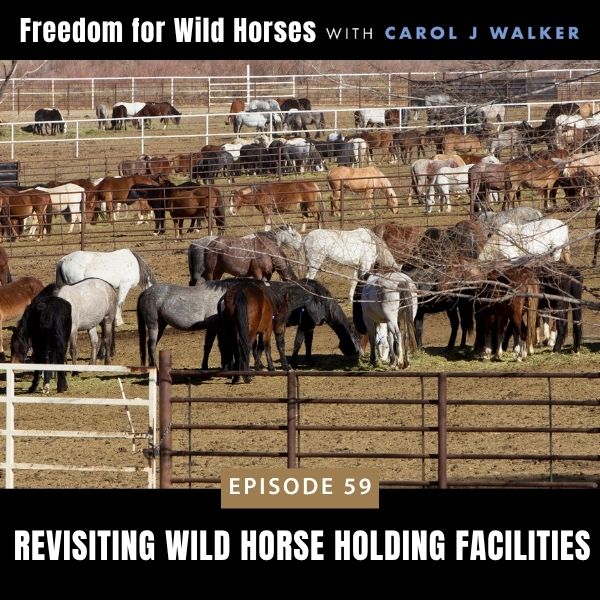
What happens to wild horses after a roundup, and how has it changed over the years? In this episode, I revisit the topic of wild horse holding facilities to examine how horses are cared for after being removed from public lands. From my earliest observations to the present, the situation has worsened, and the challenges facing these horses are more urgent than ever.
I share what I’ve learned about holding facilities across Wyoming, Colorado, Utah, and Idaho, highlighting high-level issues such as overcrowding, disease outbreaks, and the risks to mares and foals. Adoption programs meant to help often have unintended consequences, and many facilities are now private with limited public oversight. These systemic problems show why the current approach is failing the horses and why change is needed.
This episode also explores solutions. I outline steps to stop helicopter roundups, increase accountability, and return wild horses to public lands where they belong. Revisiting this topic emphasizes that advocacy and public awareness remain essential for ensuring wild horses can live freely and sustainably.
Subscribe to my blog to get more information on how you can help America’s wild horses.
What You’ll Learn from this Episode:
- How holding facilities have changed over time and the challenges horses face there.
- Why disease and overcrowding continue to put horses at risk.
- How adoption incentive programs can create unintended consequences.
- Why public access to facilities is critical for accountability.
- What needs to change to allow horses to return to public lands and live wild.
Listen to the Full Episode:
Featured on the Show:
- Subscribe to my blog to get more information on how you can help America’s wild horses.
- Follow along on Facebook and Instagram!
- Living Images by Carol Walker
- Follow my blog to get updates on the coming roundup this summer: Wild Hoofbeats Blog
- Wild Hoofbeats: America’s Vanishing Wild Horses by Carol Walker
Welcome to the Freedom For Wild Horses podcast, the place to find out about wild horses in the American West and what you can do to help them stay wild and free. If you love wildlife, wild horses, and the freedom that they stand for, this show is for you. I’m your host, Carol Walker. Let’s get started.
The first time I visited a wild horse holding facility was in the winter of 2005, after attending the Adobe Town Roundup in Wyoming. I wanted to see if I recognized any of the horses there. I set up an appointment with the BLM staff member who was in charge of adoptions at the Rock Springs Bureau of Land Management Corrals, and I arrived in the afternoon.
The very first thing I saw was a dead horse lying in one of the corrals. I saw two more dead horses in the other corrals, and the staff member was upset, claiming this normally did not happen and pleading with me not to take photographs of the dead horses. She walked with me from pen to pen, and I took photos of the horses, who now had neck tags with numbers on them and freeze brands.
The older horses were separated from the younger, and the mares were separated from the stallions, who were now geldings. There was no shelter, no shade, and I found out from locals that this facility was situated in the windiest spot in the area, truly a miserable place to spend the cold Wyoming winter. I asked her if this was all the horses and was told that many had already been shipped to long-term holding, where the horses over 10 years old would be placed and not offered for adoption.
I was looking for one horse in particular, Paprika, an older red roan stallion who had been aged at 22 when he was captured. The BLM staff member took me to her office and looked through her paperwork for an older stallion with his coloring and markings. She told me he was not on the list of horses who had died being castrated, but had been shipped to a facility in Bartlesville, Oklahoma, the Hughes Ranch. She gave me the phone number of John Hughes, and I called him, and he was willing to let me come and see the horses at his facility.
I flew into the Tulsa airport and drove to his ranch. He met with me and answered questions, and told me that the wild horses were lighter on the land than cattle. His was the very first holding facility with his initial contract in the ’70s. He took me out to the small paddocks where the new arrivals would get acclimated with higher fences than the large pastures that they would ultimately be turned out into. The grass was tall and thick, and he told me that he fed the horses hay in the winter. These were all geldings.
He also told me that the BLM could sell these older horses without limitation since the Burns Amendment had passed in 2004, and a BLM representative had come out to his ranch and told them that they could come pick up loads of horses at any time, but that had not happened yet. I spent a few hours walking through the small paddocks, looking for horses I knew, but did not find any familiar faces. Little did I know that it would become impossible to visit any of these facilities again.
In 2010, after the Adobe Town Roundup, Ginger Kathrens and I visited the Cañon City Bureau of Land Management facility at the prison in Cañon City. We got special permission to photograph the horses, and both of us posted photographs of the horses online to encourage people to adopt them. Cañon City used to have two adoptions a month.
I found the Adobe Town weanling that my friend had wanted to adopt but could not, a Palomino colt who was in the weanling pen. The youngsters were curious and interested when I walked to the fence and came up to look at me. I also walked around the huge facility, and the older stallions were very reactive and went running when anybody approached their pens, but the mares were more relaxed and barely moved as we drove through their large pens in a truck. The staff, led by Fran Ackley, were very helpful and got tag numbers of the horses for us and answered questions. The horses looked to be in good health, not thin.
I had to wait to pick up my weanling. They had not processed all of the Coggins tests for the horses yet, so the horses couldn’t be shipped out of the facility. They were going to deliver him to a trainer’s facility in eastern Colorado for gentling, but then strangles ran through the facility, and most of the young horses got sick, and many died. Luckily, my youngster, Micah, did get sick, but he recovered quickly.
The next time I visited Cañon City after the 2014 Adobe Town and Salt Wells Creek roundups, I was initially told that I could not photograph the horses because of concerns about getting prisoners working there in the shots. I assured them I had no plans to photograph any prisoners, just horses. After getting the word out on social media, asking my followers to call and request that I be allowed to do so to help these horses get adopted, Lona, who was in charge of adoptions, called and asked me to call off everyone. I could bring my camera.
We spent four and a half hours with Fran Ackley, who walked with us all over the huge facility, whose capacity was 3,000 horses. He took me from the sick pens to the pens with the 2, 3, and 4-year-olds who had been born at the facility. They were all curious, unafraid, and came right up to us. And then to the mares and the stallions that had been rounded up just a couple of months earlier.
I was identifying two families of Appaloosas that Manda Kalimian from the Cana Foundation was going to reunite at the Black Hills Sanctuary in South Dakota, but part of the family was at the Rock Springs Corrals, and Rock Springs was much slower getting the horses prepared to be adopted. So the four horses, Bronze Warrior, Snowfall, Theodore, and Diamond Girl, would head to the sanctuary now. And once the adoption happened in a few months at Rock Springs, they would all be together.
In the meantime, I got my photos up online and organized so people could see all the gorgeous horses who they could come and adopt.
In February, I traveled to Rock Springs for a three-day adoption. I and others coming to adopt horses could walk around the whole facility, which had approximately 800 horses after the roundup. We were able to walk by all the pens, except where the very young foals who had just been born were housed. I was very concerned that the pregnant mares and the mares who had very young foals were crowded too tightly in these small pens. But little did I know that one of Bronze Warrior’s mare, Wendelin, foaled during the three days I was there, and she lost the filly, Xena, due to another mare grabbing it and shaking it. We were finally able to get all the mares together, and with the gelding Sundance loaded into the trailer, we headed to the Black Hills Sanctuary.
In 2017, there was another roundup in Adobe Town and Salt Wells Creek, and I was told that because of contract issues with the prison, that the Cañon City facility was closed. No horses rounded up would be sent there, but instead, some would go to Rock Springs, and the rest would go to Axtell, Utah, and Bruno, Idaho. Both of these facilities are private, not open to the public, making it impossible to see or adopt these horses. And they could be shipped other places, all out of the view of the public. Finally, the BLM scheduled public tours of both of these facilities.
Bruno, Idaho was the first in June 2018. And we were loaded onto a flatbed with hay bales to sit on as we were driven around the facility. The truck drove slowly and stopped a few times, but we were driven, I am sure, to contain us, not to save us the walk. There was no shade, and the foals had been born and dozens had died due to a virus. The one Cremello mare I recognized from Salt Wells Creek had a little buckskin foal that I learned later also ended up dying. These disease-ridden holding facilities are not a fit place for foals to be born or for adults to be housed, either.
The second tour that summer was at Axtell, Utah, in July, and the heat was intense. We were allowed to walk around the facility and get a better view of the horses escorted by the BLM staff. None of the horses had shade.
I remember a Rock Springs BLM staff member claiming that wild horses have no shelter when they were in their homes on our public lands, but that is just simply not true. Wild horses find cliffs to shelter under, go into draws, downhills, and they are able to shelter from the wind, rain, sun, or snow. But in these pens, they have nowhere to escape the elements. They simply must endure.
In February 2021, my next visit to the Rock Springs Corrals was a surprise to me, and not a good one. There was a long line of trucks and trailers outside the facility, and people lined up at 5 a.m. at the gate to go in. Why was there this huge crowd of people? The answer, unfortunately, was the adoption incentive program.
Since 2019, people are given $1,000 to adopt a horse. The first payment is two months after adoption. The second $500 payment is two months after receiving title, a year after the horse is adopted. Over 1,000 horses have been found in auctions, dumped after the unscrupulous adopters received their payments. And I was horrified to think that this might happen to these beautiful horses.
People lined up with their paperwork in hand, charging in the gate as it opened, not even going to watch the 80 horses offered move around the corrals. I felt sick and very sad. I walked around photographing the young weanlings and the other horses in the adoption and hoped against hope that they would end up in good homes.
Before the 2020 roundup began, I had been excited to hear that finally Cañon City was open again, and most of the Red Desert Complex horses would be going to that facility, where the care had always been good. That facility was known as one of the best of the holding facilities in the country. But Fran and Lona had retired, and now Steve Leonard was in charge. I spent several months calling and emailing Steve and Vicky, the adoption coordinator, trying to get access to the horses at the facility.
There was a colt I wished to adopt and a family of wild horses I was working to help reunite at a sanctuary. I kept being told that because of COVID, they were not doing in-person adoptions. I wrote President Biden and the Secretary of the Interior Haaland each 8, 9 times. I emailed Nada Wolff Culver, the Deputy Director of the BLM, and her office finally confirmed for me that the horses I was looking for were there.
They finally sent older geldings from the Red Desert Complex plus a handful of horses from Sand Wash to an adoption in Florence, Colorado in June 2021. The minute I arrived at the facility and saw the horses, I felt like breaking down in tears. They were so thin. I could see ribs on almost all of them, and they looked so different than the last time I saw them in October 2020.
Two months later, a very limited number of people were allowed into Cañon City. I was not allowed to bring my camera or my phone, and I was horrified by what I found there. Walking in the ankle-deep mud in the mare pens, I saw very thin nursing mothers and a few emaciated mares that I knew may have lost their foals. There was hay sprinkled along rows, but surely not enough. And those very thin mares would have been separated and fed extra hay and cared for in Fran’s day. I know it. Mares who are nursing need more feed because they’re feeding their foal as well.
When I went to the yearling pen, half the yearlings were very thin, including Helios, the colt I was planning to adopt. And clearly, the more dominant colts were getting most of the hay. The less dominant ones were going hungry. Tails were chewed off. It was so upsetting seeing these horses that were not being cared for properly. Yes, there was COVID. Yes, they might be understaffed. And yes, they had less help from the prisoners. But they never should have rounded these horses up and removed them from their homes unless they could care for them properly.
I contacted the governor, my congressman, the local press, complaining of inadequate care and requesting an independent veterinarian be allowed to assess the condition of the horses. Instead, the BLM used their veterinarian, who issued a report that most of the horses were in good condition, and the two members of the press who were allowed into the facility in October were not even allowed to see the Red Desert Complex horses. They were only taken to see the Sand Wash Basin horses. Unfortunately, it was no surprise to me when horses started getting sick and dying at Cañon City in April 2022.
146 wild horses died of a combination of a virus and bacterial illness in a month. And the West Douglas horses who had died had not even been vaccinated yet. According to the BLM’s own vet report, they were moving the bodies of the dead horses with the same front loader that they used to feed the horses. The management of this facility had brought it from one of the best short-term holding facilities to one of the very worst.
Meanwhile, another huge roundup had taken place in the checkerboard herds in Wyoming. The newly opened facility in Wheatland, Wyoming has the capacity to take 3,500 wild horses. And so most of the horses rounded up were sent there and to Rock Springs. But in March 2022, just as the first adoption scheduled at the facility was about to take place, it was canceled with no explanation. Then the April adoption was canceled. I started calling and emailing the BLM to find out what had happened. Finally, I learned that strangles, which is a highly contagious disease, was sweeping through the facility, and already 11 horses had died.
The facility was closed and no adoptions took place until spring 2023. We were told 19 horses had died. There were 3,000 horses at this huge facility that is just a glorified feed lot. And the way it was set up, there was no easy way to separate out the sick horses. So they just let the illness run through the facility and waited it out. They did a public tour putting people on buses and drove them around the facility in mid-April.
And then I attended the first public adoption at the end of April. Only 30 horses, 2 to 5 years old, and 10 burros were offered for adoption. They were put in pens far from the rest of the horses at the facility, and I was not allowed to see the other horses there. These youngsters looked to be in good condition, but less than 10 of them were adopted.
The BLM used to call facilities like Rock Springs and Cañon City short-term holding facilities. And then the pastures where the older horses were sent, long-term holding. The new terminology is off-range corrals and off-range pastures. As of March 2023, there are 61,826 wild horses in holding. 21,413 are in off-range corrals. These are called preparation and maintenance facilities. And 39,215 are in off-range pastures. In the pastures, there are geldings in some pastures, and there are mares in other pastures. All of the pastures and most of the corrals are private and not open to the public.
In 2021, 13,666 wild horses were rounded up and placed in these facilities. In 2022, 20,193 were rounded up, and the summer roundup schedule for 2023 has just been released, with 5,857 planned to be removed, and then there will be even more horses on the schedule to be removed in the fall and winter.
It is very likely with this aggressive roundup schedule that this year we will see more horses warehoused in these holding facilities than remain in the wild on our public lands. The only limiting factor for the BLM is the lack of space in the holding facilities. The cost of housing these horses is by far the largest part of the BLM’s budget, ballooning out of control as the numbers increase.
This is not where our wild horses belong. They are supposed to be managed on our public lands with the least invasive methods available, not stockpiled and imprisoned in these dirty, diseased facilities where their care and feeding is at the mercy of the heads of these facilities with no public oversight. This has to change.
First, the roundups must stop. Stop. Then the public needs to be granted access to see the horses at all these private facilities at least once a month to ensure that the horses are being well cared for. And plans should be made to return these horses to the 22.7 million acres that has been lost to them.
At the time the 1971 Wild Free-Roaming Horses and Burros Act was passed, wild horses and burros were supposed to be managed where they were found at the time the act was passed. But these acres were zeroed out or permanently closed to their use. The BLM has a long list of excuses why this happened, but they could, in fact, return these horses in holding facilities to public lands that have been wrongly closed to them. The stallions are gelded, so they could live out their lives in freedom, not reproducing, at so much less taxpayer expense and managed much more humanely. Wild horses are not meant to live their lives under these conditions. This needs to stop.
Thank you for listening to this episode of Freedom for Wild Horses. If you want to learn more, follow me at www.wildhoofbeats.com for more information and for ways to help America’s wild horses. See you next time.
Enjoy the Show?
- Don’t miss an episode, follow the podcast on Apple Podcasts, Spotify or RSS.
- Leave us a review in Apple Podcasts.
3 Comments
We have hauled horses from Oregon to Illinois for a family that was relocating there because of work. We of course had to have several overnight rest stops. Upon unloading the horses at a holding area in Wyoming at 1am the horses were all very quiet. Next morning at 7am upon reloading the horses, as soon as the stall doors were opened those horses RAN to the trailer & jumped in!! I asked Lise if her families horses had ever done this before. She said” No never”. Fortunately we had the trailers doors open & so the horses could run right in. Later years later we found out that area was one of the largest holding areas for horses going to slaughter!! This was in 1987. Those horses KNEW what other horses before them had been through! At the time we were there we were the only horses at the Wyoming holding area. We need to have the SAFE act passed NOW. I presently live on a small Thoroughbred farm that my mother & I established 27 years ago here in Oregon.
Yes, we DO need the SAFE Act passed NOW! We have needed it for how many years now? And still nothing.
Horses and other animals obviously are tuned in beyond what humans can understand. Frankly in more ways than we will EVER understand.
The idea still that humans are a “dominant” species is pretty ridiculous and always was. Look what we humans have done to this planet and all the various species we have caused to be extinct. Without us – they would continue to live their lives in peace!
I do not understand why this is not on the news in all the United States. People in the Midwest or the East cannot fathom the idea of hundreds of thousands of horses that are in the western states. People in the Midwest and the East cannot possible understand. When it is discussed most people think of a few or some visual idea that the size of the wild horse round up is like a ranch that has horse back riding. What 25 the most? But yet we are talking hundreds of thousands of wild mustangs and burros. As for as the stallions. They are protectors and they will fight to the end. No one can get near them. Yet their bravery will lead them to death.
We need help from God. He needs to intercept and take their reins. I am so sorry. Thank you for being there for them and showing the pictures and videos.