
Today is the Call of the Wild – Call Congress to Protect Wild Horses
July 1, 2025
A Win at the 10th Circuit Court of Appeals for Wild Horses and the Adobe Town Roundup
July 23, 2025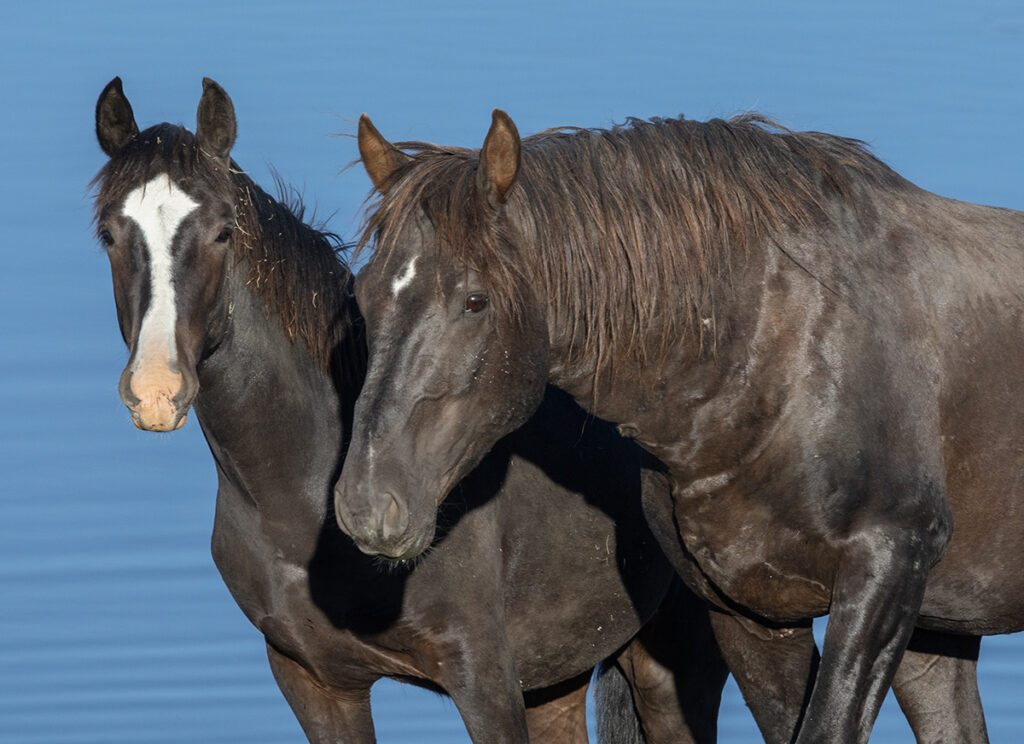
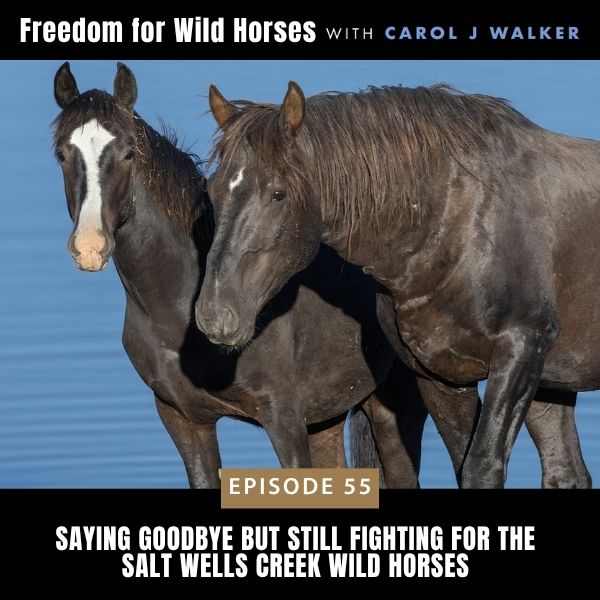
Have you ever felt your heart breaking in slow motion? That’s what it’s been like spending time with the Salt Wells Creek wild horses this year, knowing what’s coming. In this episode, I share stories from my final trip to see these incredible horses before the Bureau of Land Management plans to begin a massive roundup that may zero out the herd completely.
Salt Wells Creek is home to one of the last remaining populations of wild Curlies in Wyoming—remarkable horses with calm demeanors, thick curly coats, and powerful presence. I take you with me to high meadows and quiet waterholes, where stallions protect their families, foals play in the sun, and a surprise encounter with an abandoned filly sparks an attempt to intervene. Every moment I spent with them on this trip reminded me why this fight matters so deeply.
Though the roundup looms and the court has yet to rule, I’m holding onto the connections I’ve built with these wild horses and the memories we’ve shared. I may be saying goodbye for now, but I’m not done fighting. This episode is a tribute to their spirit and a reminder of what we stand to lose—and why we must keep showing up.
Subscribe to my blog to get more information on how you can help America’s wild horses.




What You’ll Learn from this Episode:
- Why Salt Wells Creek is home to the largest remaining population of wild Curlies in Wyoming.
- What it’s like to witness families of wild horses gathering at waterholes at dawn.
- The heartbreaking reality of an abandoned foal and efforts to seek help.
- Why the BLM’s roundup plans could eliminate these herds for good.
- How staying present with the horses offers strength for the battles ahead.
Listen to the Full Episode:
Featured on the Show:
- Subscribe to my blog to get more information on how you can help America’s wild horses.
- Follow along on Facebook and Instagram!
- Living Images by Carol Walker
- Follow my blog to get updates on the coming roundup this summer: Wild Hoofbeats Blog
- Wild Hoofbeats: America’s Vanishing Wild Horses by Carol Walker
- Ep #34: Wild Curly Horses
I’ve been involved in the fight to preserve the wild horses in the checkerboard herds in Wyoming since 2012. I’ve been a plaintiff in multiple lawsuits and have spoken out and encouraged people to comment on roundup plan after roundup plan by the BLM. But getting to know the magnificent horses in the Salt Wells Creek Herd Management Area has been one of my greatest joys. It’s a beautiful area with a variety of landscapes, from gorgeous mountains with mile-long views to rocky cliffs, dramatic buttes, and green, green meadows.
Every time I go, I learn a different part of the herd management area. And I often see the same horses, but on almost every trip, I see new ones. Right now, we are very anxiously waiting for the 10th Circuit Court of Appeals to rule on whether or not Salt Wells Creek, Great Divide Basin, and the one-third of Adobe Town that adjoins Salt Wells Creek can be converted to herd areas, which are not managed for wild horses. In other words, this will allow the BLM to zero out these herds, not leaving a single horse on over 2 million acres of public land.
The Bureau of Land Management issued an environmental assessment planning a roundup of Salt Wells Creek and the herd area portion of Adobe Town, as well as the herd management area portion of Adobe Town, which will not be zeroed out but rounded up to low appropriate management level. They are planning to remove over 2700 wild horses starting July 15th, 2025. And while the BLM says it will take several years to get all the horses in the areas to be zeroed out, that is simply not true. They are going to do their very best to take all the horses now. Most of the horses are in a few different areas. It’s supposed to start in July, and we have no idea if the court or the three judges will have ruled by then.
So I’ve been spending as much time as I can out with the horses there. My motto this year is no regrets. I want to fill myself up with the adventures I have with them, and I plan to be there standing for them during the roundup. It’s like my heart has been breaking in slow motion all year, but they are still there, and so am I.
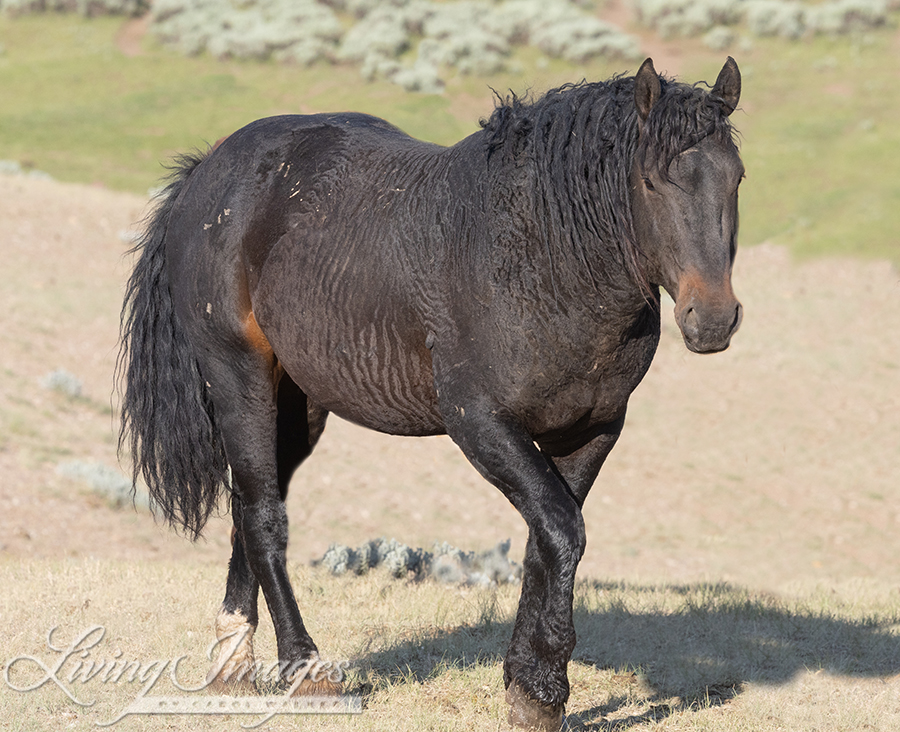
Last week, I took my last big trip to visit the Salt Wells Creek wild horses. One of the unique things about this herd is that the largest population of wild Curlies is in this herd. In fact, after the virtual zeroing out of White Mountain in August last year, they are the only herd in Wyoming with curly horses. What are Curlies? Some of the characteristics of the curly horses are a calm demeanor, friendly disposition, intelligence, a tough constitution, and great stamina. Their coats are hypoallergenic.
The curly coat comes from a gene, and some horses carry the gene and display little curliness, but can have offspring that are curly. They have tough hooves and strong bones and are usually between 14 to 16 hands tall. Their eyes can have an elliptical slant. Curlies have split manes and come in chestnuts, bays, blacks, browns, buckskins, grays, pintos, appaloosas, roans, gruyas, and cremellos. They are heavily curled in winter and much less so in summer. Their coats have a wave pattern even in summer. They all have curly hair in their ears. Their tails thin in summer, sometimes shed out completely, and then grow back in the next year. You can learn more about the curly horses in my episode 34 of Freedom for Wild Horses, which is all about them. The majority of the horses in Salt Wells Creek are not Curlies.
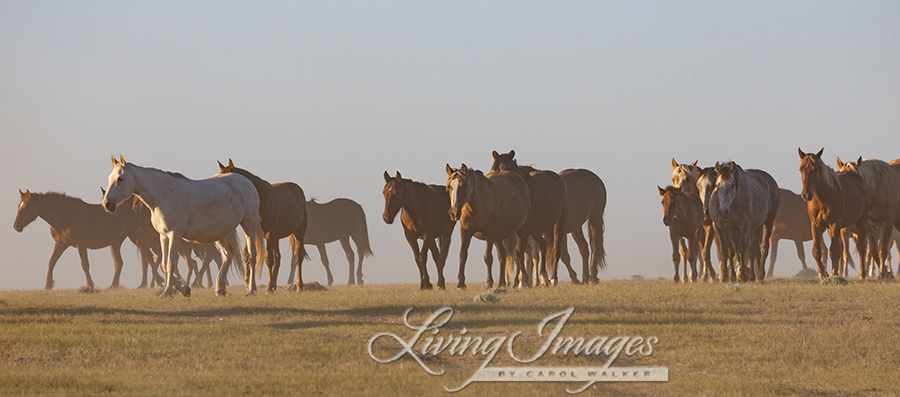
On this trip, I was lucky enough to see that a large group of horses had moved up on top of the mountain, which is a spectacularly beautiful place, before the sheep are turned out there in July or August. The views from on top are stunning, and the high meadow seems to stretch out forever, bordered by steep, dramatic ravines and drop-offs. I like to get up there before dawn because in summer, the horses go to the water holes early in the morning. And there is nothing more spectacular than being lucky enough to see a big group heading there at a run.
As I watch, I see a line of horses in the distance moving quickly, and there’s dust in the background. As they get closer, I hear some whinnies. Distinct families begin to separate out from the group, some coming closer fast, some slowing. A bachelor stallion leaps and runs in front of the group, and the first family heads down to the water to get a drink. The sun has just come up. A couple more families head down to the water, and more wait above, watching. I hear hoofbeats behind me and move out of the way over to my vehicle.
One of my favorite curly stallions, Jack of Hearts, the sorrel with the off-center blaze, comes down to the water. His family is smaller than the last time I’d seen him, and he has a lot of cuts and scars. I know there is a story or two there, and I think about the fact that I see only a very small part of these horses’ lives, moments in time when I’m there with them.
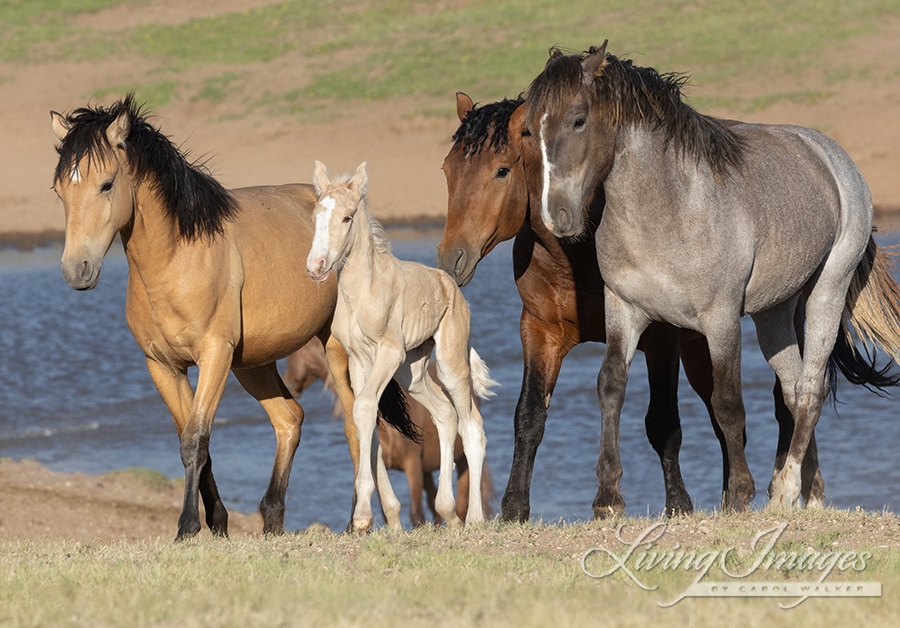
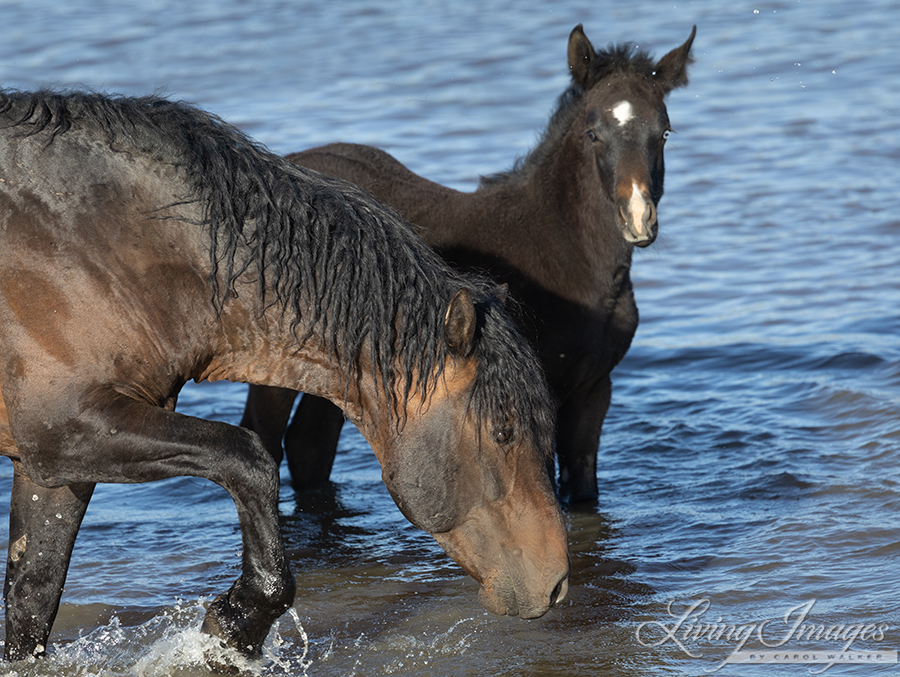
Most of the horses come down for a drink and then move back up the hill to head across the meadow. But some relish the opportunity to move toward the middle and soak and drink in a leisurely way. One of my favorite families that I seldom see is dark brown curly Ike’s family. He has a gorgeous blue-eyed filly who got right in the water with him. The whole family gets into the water together and drinks. Ike is Salt Wells Creek royalty, and he has no interest in being near humans, so I feel very lucky to see them.
As things slow down, I drive down a two-track and see some families stopping to nap in a meadow. Some continuing to move and graze. I wonder if I will see them here tomorrow. It’s an effort to keep my heart and mind in the present and just enjoy the horses and soak up their presence, but I revel in the gift that I’m given, spending time with them.
I head down the hill and drive in a loop around Titsworth Gap, but I only see one small family, a sorrel stallion and mare, and their foal. Young stallions will often keep their new families away from the big groups so they can avoid conflict.
The next morning when I get up top, I see many families of horses across the canyon on a far hill. Some are moving, others are not. They look so colorful against the green hill. I decide to wait and see if they’ll cross over to the waterhole this morning. And I’m rewarded when families come in from all different directions. I am taking photos and taking videos on my phone, and two hands don’t seem like enough. It is quiet except for the sounds of the birds and the horses.
After the horses move off to graze, I drive out, and on the way, I see a gray bachelor stallion named Rembrandt with a small palomino foal. There are no other horses around. She is a days-old little filly. He is trying to drive her toward the water, but she doesn’t seem to understand. She whinnies at me. I immediately call the Rock Springs BLM field office, as I should when finding an abandoned foal. The filly cannot survive without her mother. Foals nurse for months. The stallion cannot provide her with milk. Her only hope is if she gets fostered and bottle-fed or if a mare with one foal already nursing takes her in. Most often, abandoned foals do not survive, but I had to try. No one picks up at the BLM office, even though it is during the hours they are open, and the call goes to voicemail. I leave a detailed message for the wild horse specialist and decide that I will head down to the office in person, which is an hour away.
When I get to the BLM field office, the doors are locked, and there’s a sign saying the office is closed for Juneteenth, a federal holiday. A friend sends me the email for a BLM ranger, and I email him, and he gets back to me quickly. He tells me he has no way to transport the foal and asks for the coordinates and promises he will get with the wild horse specialist first thing the next morning, Friday. He also says if the ag person in the sheriff’s office can help, he will let me know. Frustrated, I continue on to town.
The next morning, I arrive again before dawn on the mountain and go out toward the waterhole. I see a group of horses further down the hill, so I follow a two-track down and see stallions rearing up in the dust and families on the move toward the waterhole. I return to the area I was in before, and there is the filly, but now with a different stallion, a beat-up red stallion. She looks to be as lively as the day before and follows the red stallion who is on high alert, with good reason, because soon a bay stallion steals her and moves her and his family down to the water for a drink. Then they run to the meadow. I take the coordinates on my phone and send them and a photo to the ranger and the wild horse specialist by email, since the voicemail is full for the wild horse specialist’s cell phone. I send a text, and I keep my phone on and wait.
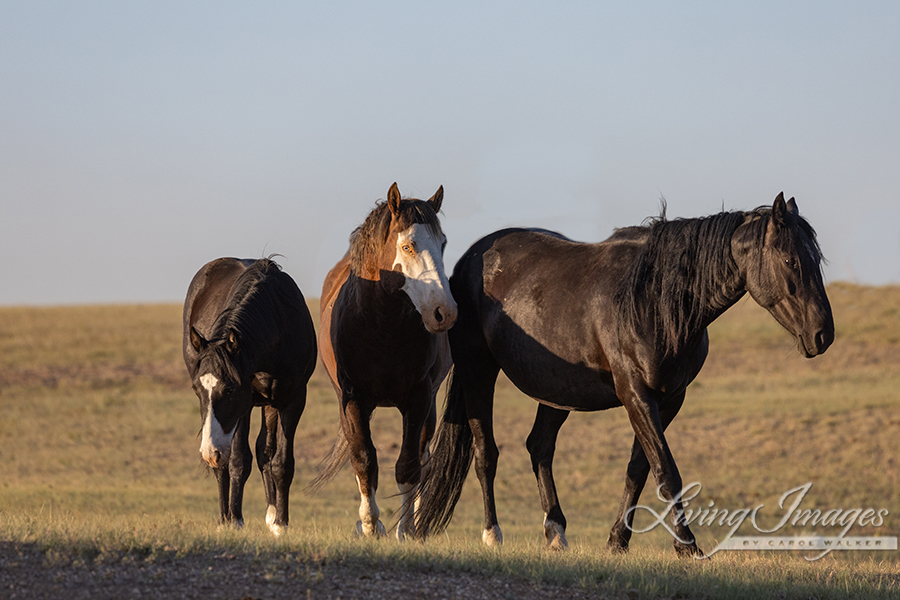
Meanwhile, more and more horses are coming from all directions to get water. Zorro, the black curly stallion with the bent ear comes, and I’m delighted to see black curly stallion Legacy with his large family. Legacy has a very dense, tightly woven curly coat that is really stunning. And one of my favorite curly stallions, the dark brown Sawyer, puts on a show as he chases other stallions away from his family. As he runs and shakes his head, and charges, he is absolutely magnificent. I see colorful pinto stallion Poncho and his look-alike foal. I see Espresso and his family coming up out of the water.
I watch as more and more horses come in and drink, then move out in different directions. Now the filly and the family she was with are out of sight. I drive along the two-tracks I can find to look for them and stay until late morning, long after the office has been open, without hearing a word from anyone. I am now assuming they have taken a long weekend with the holiday.
I drive down the mountain and see a large group of horses, mostly napping and grazing, including one of my favorite stallions, Bonfire, the liver chestnut curly stallion. He has a big golden palomino lieutenant stallion who seems to glow in the sunlight and two new foals, a black and a palomino. The palomino is barely steady on her feet. I stay with them until they move off down a hill with a group of other horses, including some rowdy bachelors who get the whole group running. And then I see the bay curly stallion Blaze with his dense, crushed velvet coat, with a palomino mare and her foal run down the hill to join the other horses.
The next morning, as I drive up on the mountain, I only see a couple of families nearby. The night before, a big storm had moved in with lots of wind, and the horses had scattered, so I headed down the hill. There’s another waterhole near the road that did not have water in it last month, but now is mostly full, and the horses were using it. It’s not far from where I had seen Bonfire the day before, so I waited to see if the horses would come. A big group on the run goes to the waterhole first, splashing and some rolling in the mud. I see other horses at the top of the hill with youngsters playing and running. Silverado, the silver dapple stallion’s colorful family comes down, and so does Bonfire’s family. As I start to leave, three more families come down the hill. This is my last day with the Salt Wells Creek wild horses.
On my way home, I go to Adobe Town, where my journey with the wild horses began 21 years ago. I see a few families, but many more bachelors in groups and alone, typical since the incredibly harsh winter of 2022 to 2023, which killed so many horses, most of them mares. As I was driving, I realized that I was grieving. Grieving all the horses over so many years that had been removed from their homes, and grieving for the Salt Wells Creek horses, who despite my best efforts and the efforts of so many others, seem to be destined to be rounded up and zeroed out, lost forever to this wild and stunning land.
And then, as I drive down the road that became so familiar to me in 2004, in the same area that I used to find the battle-scarred gray stallion, who I never saw again after the 2005 roundup, I saw him. A stunning and proud pure white stallion standing watch over his family. The wild horses of Adobe Town are typically very skittish about humans, sometimes running before I get out of my car. But this stallion watched me. I had never met him before, but he allowed me to approach and sit. Then his mares and youngsters became curious and walked down the berm to take a look at me. There were two foals in the group. The palomino shy, hiding behind his mom. We sat there, and I soaked in the peace, the joy from spending time with them. This was what I had needed. After a while, I got up and walked to my car, and they moved off to graze. But the connection and the truth of it steadied me for the time that is to come, and I’m grateful.
Thank you for listening to this episode of Freedom for Wild Horses. Follow my blog at www.wildhoofbeats.com to get updates on the coming roundup this summer.
Thank you for listening to this episode of Freedom for Wild Horses. If you want to learn more, follow me at www.wildhoofbeats.com for more information and for ways to help America’s wild horses. See you next time.
Enjoy the Show?
- Don’t miss an episode, follow the podcast on Apple Podcasts, Spotify or RSS.
- Leave us a review in Apple Podcasts.
1 Comment
I enjoyed the descriptions of the different curlies..brown, white, tight curls… splashing of water , dust going up down hills…Stallions studying and stances, anxyst w filly BLM situation, new Stallions w filly, Wow no way to turn , trying to enjoy, situation intensifying impending doom seemingly, par for course, no answer/assist, years of time spent vs last time there. Carol I’m just so frustrated for you then and sorry for how you feel. This is so difficult for me, I know for lot of us (many) but I can’t imagine how so for you. I know how you have adored the curlies (following you for so long) so many pics of Bubba and his herd and buddies. Well At least it was good weather, the other water hole got filled up. I hope that filly made it somehow. And you saw a lot of horses. I do not know how they can begin before court is completed….they are corrupt thru & thru.