
Ep #61: The Lost Horses: It’s Time to Pass the SAFE Act
November 17, 2025
Ep #63: Revisting Wild Curly Horses
December 29, 2025
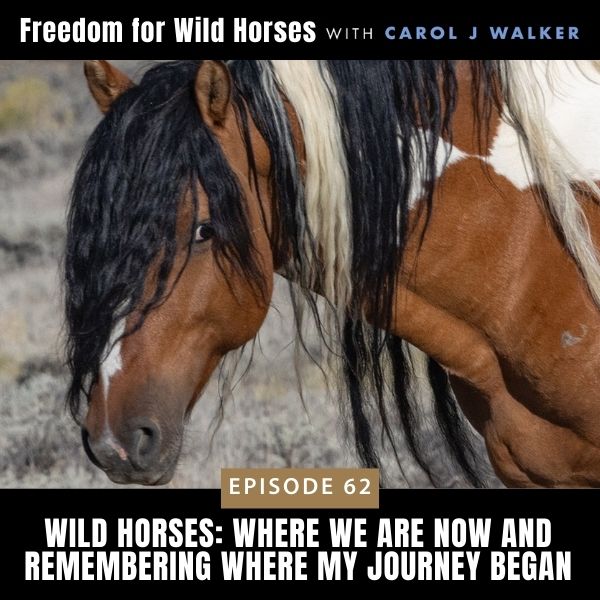
Have you wondered what is happening with America’s wild horses as 2025 comes to a close? In this episode, I share a clear look at where things stand today, from the continued reliance on helicopter roundups to the lack of progress using humane birth control that would allow wild horses to remain on our public lands. After more than twenty years of observing these herds, the gap between what the law intended and how wild horses are managed has never felt more evident.
I also break down the political forces shaping the future of these herds, including how appropriate management levels are set, what the most recent government funding does and does not protect, and why Project 2025 continues to cast uncertainty over the years ahead. With staffing cuts and postponed gather schedules adding to the complexity, this moment calls for clarity about what these decisions truly mean for wild horses.
In this moment of reflection, I return to why these horses matter and share an excerpt from my first book, Wild Hoofbeats: America’s Vanishing Wild Horses. You will hear the story of my earliest experience with a wild horse family in Adobe Town and why spending time with the Salt Wells Creek herd this year carried such urgency. This episode offers both an honest look at the challenges ahead and a reminder of what we are fighting to protect.
Subscribe to my blog to get more information on how you can help America’s wild horses.
What You’ll Learn from this Episode:
- Why the Bureau of Land Management continues to use helicopter roundups.
- How appropriate management levels are shaped by politics rather than science or genetic viability.
- What the most recent Congressional funding decisions mean for wild horses through January 2026.
- How Project 2025 threatens the wild horses currently in holding facilities.
- Why spending time with the Salt Wells Creek herd became so important this year.
- What my first encounter with a wild horse family in Adobe Town revealed about their behavior and resilience.
Listen to the Full Episode:
Featured on the Show:
- Subscribe to my blog to get more information on how you can help America’s wild horses.
- Follow along on Facebook and Instagram!
- Living Images by Carol Walker: Salt Wells Creek | Red Desert Complex
- Follow my blog to get updates: Wild Hoofbeats Blog
- Learn more about my book, Wild Hoofbeats: America’s Vanishing Wild Horses by Carol Walker
Episodes Related to Wild Horses Now:
- Ep #56: A Win for Wild Horses and a Roundup
- Ep #58: A Journey for Wild Horses and a Reprieve
- Ep #59: Revisiting Wild Horse Holding Facilities
Welcome to the Freedom For Wild Horses podcast, the place to find out about wild horses in the American West and what you can do to help them stay wild and free. If you love wildlife, wild horses, and the freedom that they stand for, this show is for you. I’m your host, Carol Walker. Let’s get started.
It’s been 21 years since I first started visiting and photographing wild horses. Not much has changed in that time in the management of them. The Bureau of Land Management is still using helicopter roundups and removal as the primary method for keeping wild horse populations to their appropriate management level, instead of using safe, humane, proven birth control to keep them in their homes on public lands.
On December 15, 1971, the Wild Free-Roaming Horses and Burros Act was signed into law. Although the act was passed unanimously by both houses of Congress, wild horses and burros have not been protected the way that the act laid out. And many of the herd management areas that they live in have been slowly zeroed out and turned into herd areas not managed for wild horses.
Appropriate management levels are set not based on science or on the amount of horses needed in a herd to ensure genetic viability, or on the scientific evaluation of the carrying capacity of all wildlife in an area, but on politics and pressure from the livestock ranchers who lease our public lands for a pittance and whose cattle and sheep devastate our lands by overgrazing.
On November 12, 2025, Congress passed a continuing resolution funding the federal government through January 30, 2026. This maintains fiscal year 2025 funding levels for the BLM’s Wild Horse and Burro Program and protections against killing and slaughter of the wild horses remaining in place for the 64,000 wild horses currently in holding facilities.
But funds are also available for helicopter roundups, and those may resume. There has been a hold on these roundups since summer and through the government shutdown, and the BLM has not released the gather schedule for fiscal year 2026 yet. The staff of the Wild Horse and Burro Program has been cut drastically this year.
The specter of Project 2025, calling for the killing of wild horses in holding, continues to loom large for at least the next three years. This year, I spent as much time as I could with the wild horses in Salt Wells Creek, one of my favorite herds.
Despite our lawsuit continuing, being sent back to the Wyoming District Court, the BLM had put the roundup to zero out the herd, taking every last horse, on their gather schedule. And it was important to me to spend as much time with the horses as possible before they were captured and gone forever. The roundup was postponed twice and finally, after a second lawsuit was filed, put on hold until next summer, 2026 at the earliest. More time is always a good thing for our wild horses.
In the midst of this time of uncertainty, I think it’s important to come back to why wild horses are important and where my journey with them began. This excerpt is from my first book, Wild Hoofbeats: America’s Vanishing Wild Horses, and it’s about my first experience with a family of wild horses in the spring of 2004:
“It is late April, the morning of my first day looking for horses in Adobe Town. I have been searching the landscape for sight of the herd, but so far even my binoculars have shown me nothing except endless acres of sage and pale soil, tossed up into mocking dust devils by the spring wind.
I force my car over deep ruts, wrench the steering to round a bend in the primitive road, and spot a graceful white mare standing 75 feet from the car. Her eyes are closed as she sleeps on her feet, and below her, ears are sticking out from the sagebrush. A band of wild horses is lying down, sheltering from the bitter wind that seems to blow continuously in this area.
I grab my camera and button my coat, my fingers fumbling with the buttons as I rush. When I get out of the car, I leave the door ajar to avoid making unnecessary noise. I ease toward the horses. Abruptly, a light gray horse with a charcoal mane lunges to its feet and begins running toward me. I realize that this must be the stallion. As he gets closer and closer, I wonder if he’s going to stop. I also wonder what I will do if he doesn’t.
As he approaches, more horses behind him unfold their bodies and rise up from the sagebrush. I see two fillies, one a gawky yearling and the other a sturdier two-year-old. I am a statue. The stallion slows to a trot and then stops about 10 feet away from me, and I finally breathe, thrilled to see him so close.
He is downwind, so he can smell me. He seems to be inspecting me as avidly as I am him. From the many bite marks and scars sprinkled across his white coat, he’s clearly an older stallion. Once he has taken a good look, he seems to relax and strolls over to the younger of the two fillies, who are standing together looking at me. The two sisters look alike with similar straight blazes on their faces, but the smaller filly’s blaze tapers between her eyes like an hourglass. She is a reddish color but is turning gray like her mother and father.
The stallion stops beside her and affectionately nuzzles her, and she nuzzles him back. Then he walks over to the larger filly, who is a rosy pink in color, and nuzzles her. She lifts her head, showing her teeth as though she were grinning at me. I laugh, and luckily, the horses don’t seem to care after all about the noise I made. The mare hangs back, watching her daughter’s antics. Her belly is very large with this year’s coming foal. Not wanting to interfere in their morning activities, I leave when the horses start becoming restless.”
This was the first of many trips I took out to Adobe Town that year, and I’ve continued to visit that area over the last 15 years. And this summer, there was a devastating roundup that took far more horses than should have been allowed by the numbers left in the herd.
Thank you for listening to this episode of Freedom for Wild Horses. If you’d like to know more about my book, Wild Hoofbeats: America’s Vanishing Wild Horses, go to www.wildhoofbeats.com.
Thank you for listening to this episode of Freedom for Wild Horses. If you want to learn more, follow me at www.wildhoofbeats.com for more information and for ways to help America’s wild horses. See you next time.
Enjoy the Show?
- Don’t miss an episode, follow the podcast on Apple Podcasts, Spotify or RSS.
- Leave us a review in Apple Podcasts.
2 Comments
Thank you , Carol , for doing these educational videos..
Homing district, many of the wild horses in the holding should be re.Released into their home range , as there are millions of acres designated for them. We know all too well the dastardly deeds of some of the contractors and BLM upper management employees on behalfofcattleman’sassociations..
Thank you, and thank all of you for everything you have done on behalf of wild horses and burros…
I agree with your whole comment Elaine.
There is so much wrong with “management” of our Wild Horses & Burros – there has been for decades through both Democratic and Republican administrations. Neither raises a finger to make any changes no matter how many Wild Horse & Burro advocates speak out – no matter how absolutely clear it is what’s being done to these native wild animals – so many letters & comments & court cases – yet our “representatives” block all of out & continue to allow and profit from extraction of our natural resources – one of which IS our Wild Horses and Burros.
My own Democratic Senators – IF they replied – only spewed the BLM or FS BS propaganda.
There are so many reasons for a change in DC – both republican AND democrat!
But what has been perpetrated by these “elected” officials is as much a crime as what has been done to Wild Horses & Burros for too many decades.
Thank you, Carol, for all you try to do for these fantastic creatures.