
Ep #62: Wild Horses: Where We Are Now and Remembering Where My Journey Began
December 8, 2025Presentation on Saving and Spending Time with Salt Wells Creek Wild Curly Horses
January 12, 2026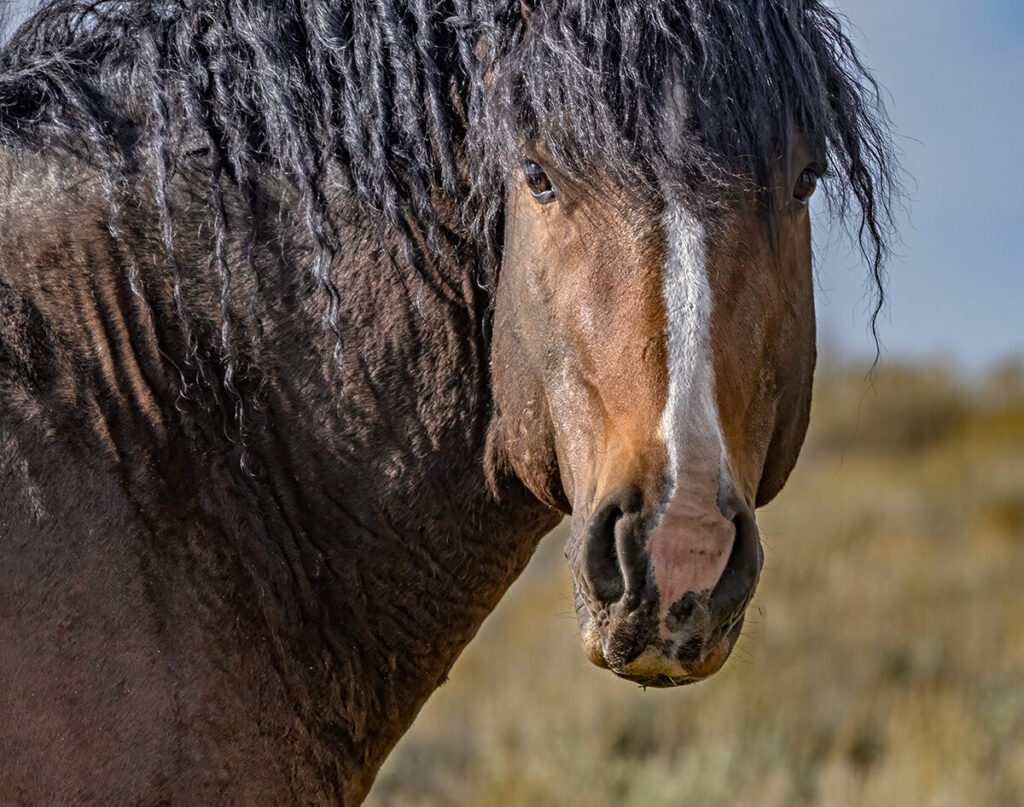
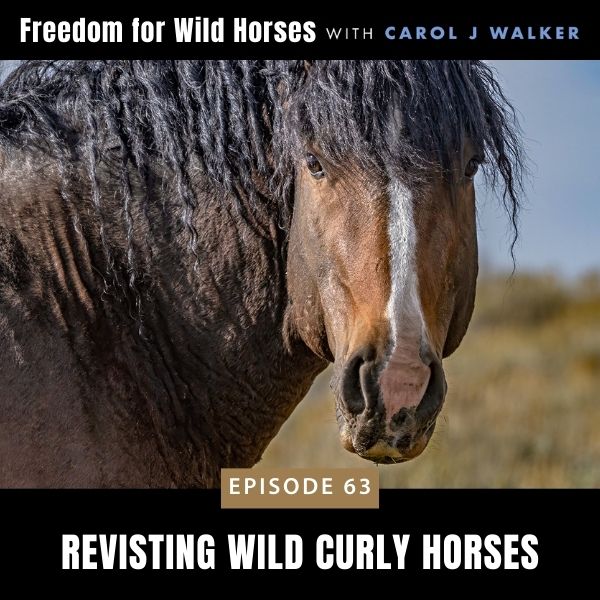
Have you ever wondered what makes a wild curly horse so distinctive? In this episode, I revisit my first experiences with the curly horses of Salt Wells Creek and share how discovering this rare lineage changed the way I understood the diversity within America’s wild horse herds. These horses carry traits that set them apart from others on the range, and encountering them for the first time revealed just how unique this population truly is.
I talk about the wide range of curliness found in this herd, from horses whose coats shed dramatically in spring to those whose curls soften or disappear entirely in summer. I also explain what makes curlies genetically different, how their characteristics have been documented across history, and why they have become so valued by both breeders and advocates. Their presence in Salt Wells Creek represents one of the rarest wild curly populations in North America.
As I revisit this story, I also share why these horses are now at risk. Salt Wells Creek is one of the herds slated for full removal under the new land use plan, and curlies were notably absent from public adoptions after the most recent roundup. I hope this episode encourages you to learn more about what is happening to these unique horses and to take action to help protect the wild curly herds that remain.
Subscribe to my blog to get more information on how you can help America’s wild horses.
What You’ll Learn from this Episode:
- How curly horses first appeared in North America and the earliest known records of them.
- What makes a curly horse physically and genetically different from other wild horses.
- Why curly horses survived some of the harshest Nevada winters when others did not.
- How their coats and traits change between seasons and across individual horses.
- Where the Rock Springs curly lineage originated and how it connects to Salt Wells Creek.
- Why curly horses disappeared from public adoption lists after recent roundups.
Listen to the Full Episode:
Featured on the Show:
- Subscribe to my blog to get more information on how you can help America’s wild horses.
- Follow along on Facebook and Instagram!
- Living Images by Carol Walker: Salt Wells Creek | Red Desert Complex
- Follow my blog to get updates: Wild Hoofbeats Blog
- Learn more about my book, Wild Hoofbeats: America’s Vanishing Wild Horses by Carol Walker
- Map of Salt Wells Creek HMA
- International Curly Horse Organization
- American Bashkir Curly Horse Registry
- American Wild Horse Conservation
Episodes Related to Wild Curly Horses:
- Ep #51: Comment Against the Zeroing Out of Wyoming’s Checkerboard Herds
- Ep #55: Saying Goodbye but Still Fighting for the Salt Wells Creek Wild Horses
- Ep #60: Connecting with the Wild Horses of Salt Wells Creek and the Red Desert Complex
Welcome to the Freedom For Wild Horses podcast, the place to find out about wild horses in the American West and what you can do to help them stay wild and free. If you love wildlife, wild horses, and the freedom that they stand for, this show is for you. I’m your host, Carol Walker. Let’s get started.
I didn’t know anything about curly horses until a trip to visit Salt Wells Creek in Wyoming to visit this herd of wild horses in the spring of 2018. I had visited this herd before, but given it was almost a million acres in size, it makes sense that I was unfamiliar with this particular area that my friend Meg invited me to go with her to visit.
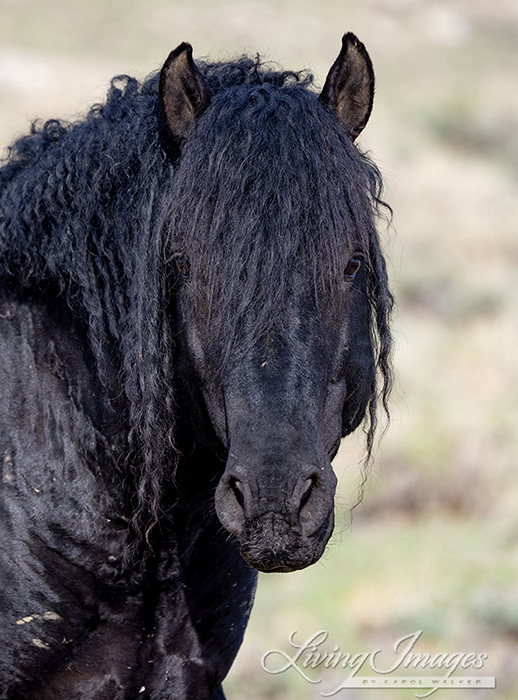
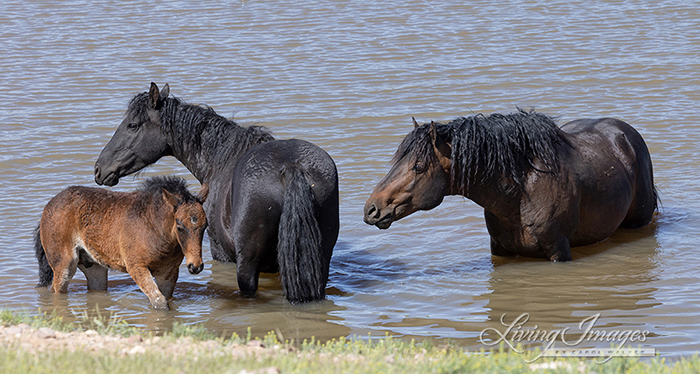
A wild black stallion named Bubba was my first introduction to curly horses in this herd. His long curling ringlets of mane and his thick curling coat were amazing looking, and he was so large and heavy. He reminded me of the horses that the medieval knights of old rode. And when he galloped by chasing another stallion away from his family, I could feel the ground shake. And he was a very gentle guy, very kind to his mare and his foals. And I was just entranced by him.
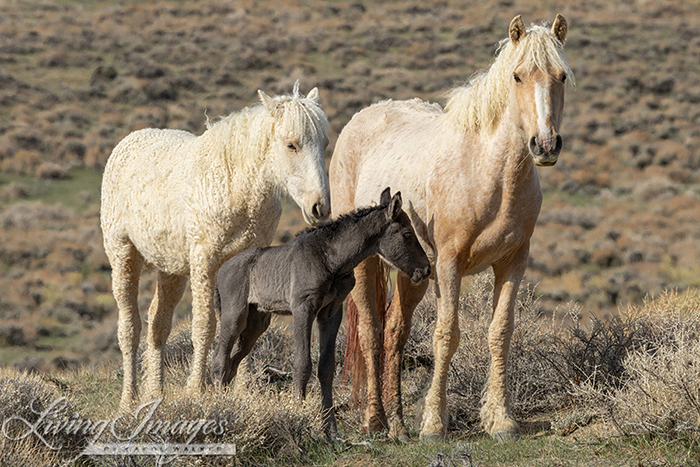
There were other curly horses in this area of Salt Wells Creek. There were three other black stallions that were curlies: Bobby, Rocket, and Zorro. This year, Rocket has three offspring, and the only one whose dam is a curly palomino is Curly, a little black colt I named Tristan. The sorrel mare and the gray mare, who are not curly, have foals that do not show curliness.
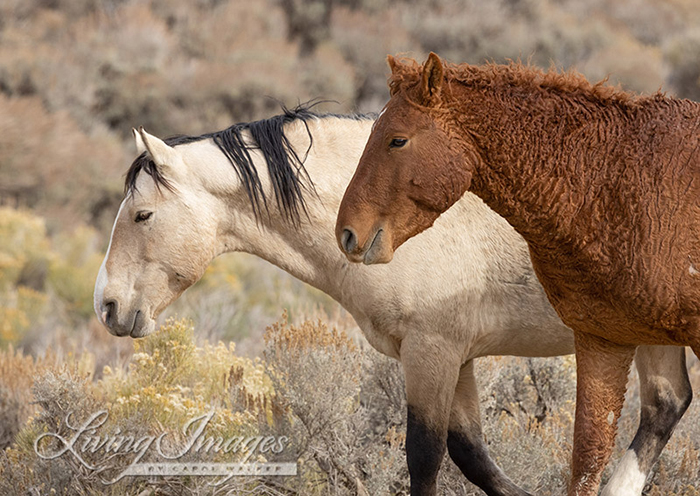
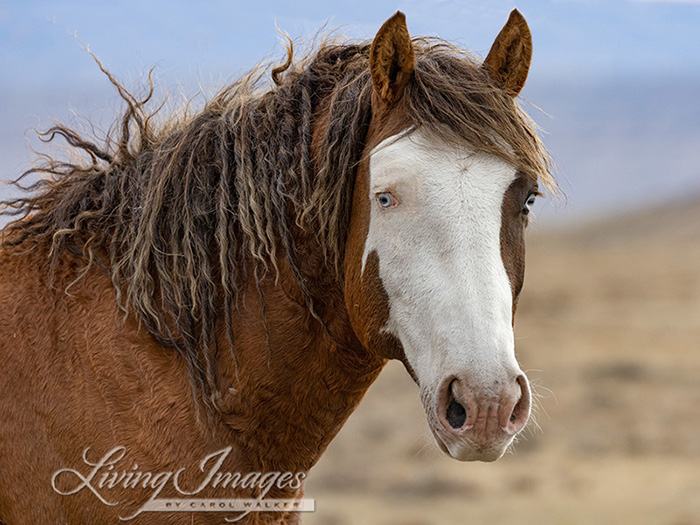
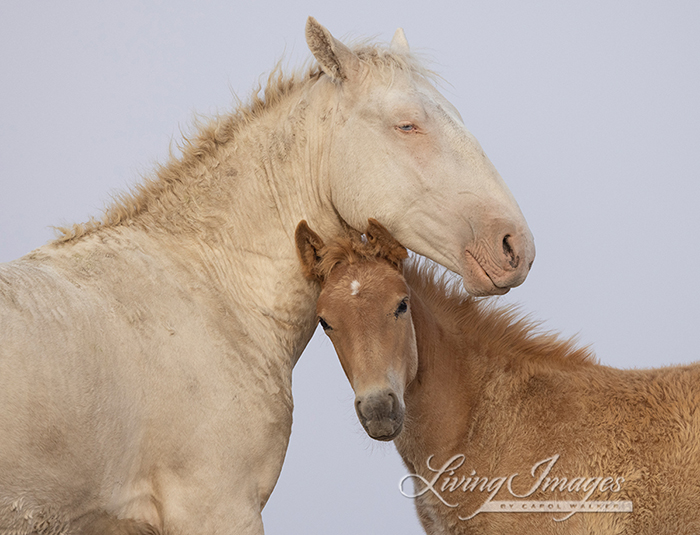
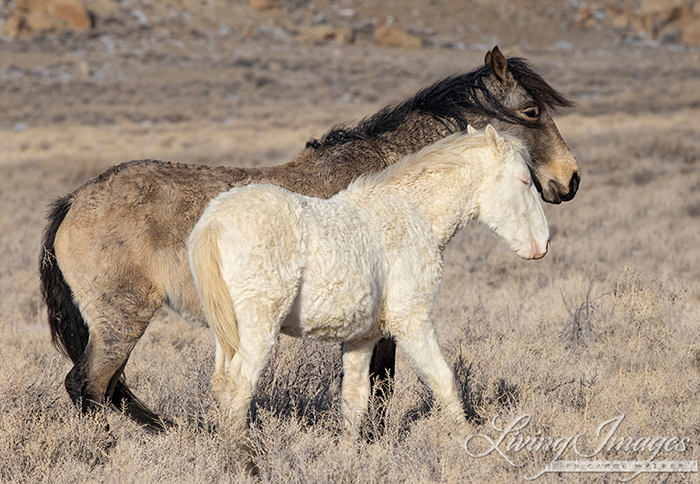
I was intrigued to find that there were varying degrees of curliness. Cassidy is a reddish sorrel bachelor stallion, and the waves and curls in his coat, even in the summertime, are dense and thick. Julian, the curly cremello I fell in love with at first sight after he was born, had such a thick curly coat as a foal that he looked like a little lamb with curly hair in his ears. And then as he grew into a 2-year-old, in the summer, his curls would fall out, his coat would be much thinner, and his tail became short and sparse.
This change from winter to summer is common for curly horses, especially for what are known as extreme curlies. The stallion Mooney is one of those. When he sheds his coat in late spring, the hair comes off in patches or sheets like a bison, leaving him bare underneath with very little hair in his mane and tail.
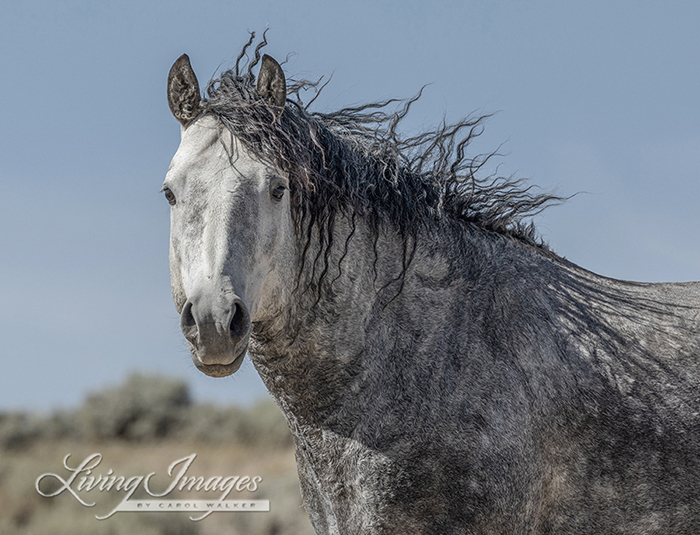
Another thing that puzzled me, the dramatically colored blue-eyed curly stallion named Jack of Hearts has some curly foals and some that are not curly. On the other hand, curly bay stallion Ike, with a thick curly coat, has only curly offspring in his family. The wild stallion Dollar is the only gray curly that I know of in this herd. His mane sticks up in lush curls, and he has a large family with mostly sorrels and curly offspring.
On doing some research into curly horses, I found that there’s an international organization that has a registry and history posted on their website: The International Curly Horse Organization. And they call them North American Curly Horses. There’s also the American Bashkir Curly Registry, and they call them the American Bashkir Curly Horse. However, it has been found unlikely that the Russian Bashkir horse is an ancestor.
Although it seems to be a mystery how curly horses originally came to North America, the earliest documentation is evidence that the Sioux Indians had stolen some curly horses from the Crow Indians in 1801 or 1802. And they can also be traced to reservations in South and North Dakota, acquired from wild horses.
Both of the organizations I mentioned agree that the first modern-day documentation of curly horses in North America date to 1898 in central Nevada with the Damele family, who captured wild curly horses and then began a breeding program. They had observed that these horses were unusually hardy and some of the lone survivors after the harsh winters in 1932 and 1951. And this family bred curlies with other breeds, and then the resulting horses were the foundation of the current breed.
Some of the characteristics of the curly horses are a calm demeanor, a friendly disposition, intelligence, a tough constitution, and great stamina. Their coats, interestingly enough, are hyperallergenic. The curly coat comes from a gene, and some horses carry the gene and display little curliness but can have offspring that are curly.
They have tough hooves and strong bones, and usually are between about 14 to 16 hands tall. Their eyes can have an elliptical slant. Curlies have split manes, and they come in chestnut, bays, blacks, browns, buckskins, grays, pintos, appaloosas, roans, grullas, and cremellos. They are heavily curled in winter and much less so in summer. Their coats have a wave pattern even in summer, and the coats can even look like crushed velvet. They all have curly hair in their ears. Their tails generally thin in summer, sometimes shed out completely, and then grow back in the next year.
There are wild curlies in Nevada, and there are also two herds with curlies in Wyoming: White Mountain and Salt Wells Creek. The Wyoming herd that has the most curlies is Salt Wells Creek. According to the International Curly Horse Organization, the wild curlies in Wyoming are only in the Rock Springs area. They are rarer than the wild Nevada curlies. They are a unique pocket of curlies that are stoutly built with excellent temperaments.
The Rock Springs curlies can be traced back to one famous curly horse, the Laramie Stud. He was purchased from a horse trader in Laramie between 1942 and 1945 by a man named Isaac Newton Brooks. The Laramie Stud is the father of a curly stallion named Rocket, the foundation of the Rock Springs curlies.
These horses belonged to Ike and his nephew, John Napps, but when the Bureau of Land Management no longer allowed the ranchers to use the land for horse breeding, the remnants of this herd left on the land became the Rock Springs wild curlies. Some of these horses were shipped east in the early 50s. Through genetic testing, there’s proof that the Salt Wells Creek curly line carries the curly gene KRT25, as do the Nevada curlies.
As I was writing this, I remembered seeing two magnificent stallions, one bay and one black, who looked so much like the noble horses I remember from medieval paintings of the knights: stout, with proud, thick, arching necks, at a BLM holding facility in 2014 after a roundup in Salt Wells Creek. And these two horses had curly coats.
I was told they were not going to be gelded, which is strange because normally the BLM gelds all the stallions that come through before they’re adopted, but they were being saved for a breeder of curlies back east. These days, the BLM in Rock Springs does not allow stallions to be adopted without being gelded.
However, after the 2021 roundup in Salt Wells Creek, curiously, there were no curlies offered for adoption at Rock Springs. What happened to the curlies that had been rounded up? I know they are much in demand.
When I went to the private facility in Wheatland, Wyoming, where most of the 3,500 wild horses that had been removed during the Checkerboard roundup of five herds, which included Salt Wells Creek and White Mountain, that does have some curlies as well, I asked, “Do you have any curlies here at the facility?” I got several vague, non-committal answers.
And since the facility does not allow the public in to see all the horses in that huge facility, which has a capacity for 3,500 horses, but just brings out 30 to 40 to the outer pens for adoptions, there was no way for me to go and look and check.
But later in 2022, I heard there had been some curlies shipped to Texas, and at least one BLM staffer had ended up with one. I think perhaps quite a few BLM staff and BLM friends end up with curlies before any horses are offered to the public for adoption, which is actually against their own rules.
And now Salt Wells Creek is one of two herds, along with Great Divide Basin, that is slated to be zeroed out entirely under the new land use plan. Yes, curlies are rare and unique and precious, but none of the horses in either of these two herds deserve to be removed, and their entire herds eradicated simply to appease the Rock Springs Grazing Association.
Thank you for listening to this episode of Freedom for Wild Horses.
Thank you for listening to this episode of Freedom for Wild Horses. If you want to learn more, follow me at www.wildhoofbeats.com for more information and for ways to help America’s wild horses. See you next time.
Enjoy the Show?
- Don’t miss an episode, follow the podcast on Apple Podcasts, Spotify or RSS.
- Leave us a review in Apple Podcasts.
3 Comments
Fascinating, Carol. They are so beautiful as all wild horses are, but those curls!!
Shameful if they are removed just so BLM employees can have them OR more likely sell them for a personal profit.
This whole land use thing is a nightmare in so many ways.
I just want to correct the mistake I made calling Jack of Hearts, Ace of Hearts! My apologies!
Thank you for writing informative article.